Need a certified translation? USCIS · legal · medical · academic (407) 537-2522 Get a quote →
AI data & language services Quote Request a scope
Industry · AI/ML

Build AI and ML language programs around the quality check, not the word count.

AI and ML language problems do not resolve themselves through volume. A large annotation batch where annotators across locales apply the label categories differently produces a dataset that looks complete but introduces systematic bias before the training run begins. A model evaluation in ten languages where the evaluators have different interpretations of the task rubric produces a quality score that does not reflect actual cross-lingual performance. DD structures AI and ML language engagement around the quality check — the criterion the buyer will apply to decide whether the returned data is acceptable — before production begins.

A language data reviewer scoring model output against an evaluation rubric on screen
250+ Languages
40,000+ Vetted linguists
Separation of roles At every production stage
1 Named PM per program
Evidence for review

What DD can show before a buyer commits.

This is not a public case study claim. It is DD-owned evidence a buyer can request when the work needs vendor review before a scope is approved.

Ask for proof details
Buyer type
AI/ML buyer, compliance owner, program lead, or vendor manager qualifying a regulated language supplier.
Problem
The buyer needs ai/ml language work scoped with the setting, audience, access controls, and review process confirmed before commitment.
Scope
AI/ML work across files, sessions, media, or data tasks where privacy, recipient requirements, and audit expectations matter.
Constraint
Regulated buyers need proof without public client disclosure; DD cannot publish client-specific outcomes unless the client clears them.
DD action
DD confirms the ai/ml use case, content handling, role-scoped access, review chain, and missing inputs before production.
Evidence available
Private proof can include a redacted request checklist, access-control checklist, QA summary format, and delivery record format for the relevant setting.
Outcome
The buyer can verify whether DD can handle the setting before sharing sensitive content or scheduling the engagement.
Disclosure status
DD-owned proof only. Public client outcomes require approval; redacted process artifacts can be shared when disclosure terms allow.

How DD checks it

What enterprise buyers need from ai/ml — and how DD delivers it.

DD confirms the task type, the task rules, the sample record, the language list, and the quality check before production begins. That separation prevents the most common AI data failure mode: a production batch that the buyer must reject or re-label because the task rules were interpreted differently across annotators, languages, or locales.

Annotation and labeling quality in AI programs depends on cross-annotator consistency: whether annotators applying the same instructions to the same content across different locales arrive at the same label. DD tracks cross-annotator consistency on all annotation projects. If annotators for the same language are applying label categories differently, that is flagged before the batch is released, not discovered when the training run produces unexpected behavior. Unclear examples, ambiguous label cases, and instruction edge cases are documented and returned with the batch, not silently forced into a category.

Model evaluation requires linguists who understand the task rubric, the target language, and the cultural context of the content being evaluated, not just bilingual capability. A safety evaluation task where the evaluator does not understand the cultural register of the target language produces a safety rating that does not reflect actual model behavior for speakers of that language. DD confirms the evaluation rubric, the content domain, and the language-specific calibration expectations before evaluation assignments are made. Inter-rater alignment checks are available for evaluation programs requiring documented consistency across reviewers.

Speech and audio data programs including speech transcription, audio review, pronunciation assessment, and spoken-language dataset quality checks require linguists who can assess fluency, naturalness, and dialect accuracy, not only transcription accuracy. For speech model training data, DD scopes the review criteria against the model's target speaker population: accent, dialect, age, and register expectations that the model must generalize across. For accented or lower-resource language speech data, DD checks linguist qualification for that specific variety before the review assignment is made.

RLHF and preference annotation programs require annotators who can assess not only factual accuracy but tone, cultural appropriateness, helpfulness, and safety nuance in the target language. Those judgments differ across languages in ways that are not visible from the English-language rubric alone. DD confirms the preference criteria, the target language population, and the annotation examples before the program opens. For programs requiring rotating annotator pools to reduce individual-annotator bias, DD structures that rotation into the delivery plan when the program opens.


In the tool

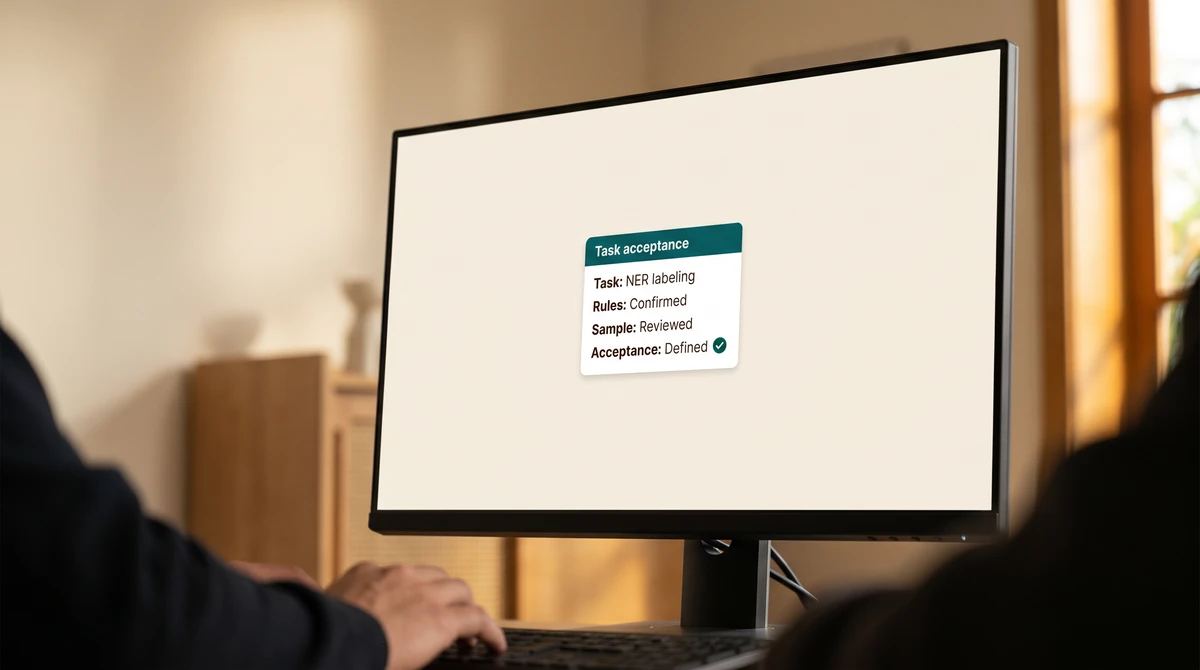
Task rules, a reviewed sample, and the acceptance check defined before production — so a batch is not rejected at the training run.

A close-up of an AI-ML task acceptance card showing task type, confirmed rules, reviewed sample, and defined acceptance criteria

Step by step

  1. Share task type, task rules, and a sample

    Send the task type (annotation, evaluation, speech review, RLHF), task rules, a sample record, the language list, output schema, volume, delivery cadence, and the quality check your team will apply to decide batch acceptance.

  2. Quality check confirmed before production

    The acceptance criteria, the test the buyer will apply to decide whether the batch is acceptable, are confirmed before production begins. This prevents the most common AI data failure: a batch rejected because task rules were interpreted differently across annotators or locales.

  3. Production with cross-annotator consistency tracking

    Annotators self-check against schema guidelines. A senior reviewer independently samples the batch and checks for cross-annotator label drift before any batch is released. Ambiguous examples are documented and returned, not silently forced into a label.

  4. Batch delivery with quality metrics reported

    Each delivery includes completeness, schema compliance, and cross-annotator consistency metrics. Systematic issues are caught at batch level, not at the training run.

Quality and delivery

What buying teams need. What DD structures every engagement around.

Quality check defined before production

DD confirms the task type, the task rules, the sample record, and the quality check the buyer will apply to decide batch acceptance — before production begins. That prevents the most common AI data failure: a batch the buyer must reject because the task rules were interpreted differently across annotators or locales.

Cross-annotator consistency at every batch

If annotators for the same language are applying label categories differently, that is flagged and resolved before the batch ships — not discovered at the training run. Batch-level quality metrics — completeness, schema compliance, consistency — are reported at every delivery.

Separation of roles at every stage

The annotator is not the reviewer. Annotators self-check against schema guidelines; a senior reviewer samples the batch and checks consistency; the PM validates completeness and schema compliance before release. That chain is documented, not verbal, and applies at every delivery.

Rolling-batch pipeline delivery

Content can be received incrementally and returned processed on a defined cadence — no need to wait for a complete source dataset. Schema, label format, and output requirements are matched to the downstream pipeline specification agreed when the project opens.

Quality-management controls Information-security controls Translation-review controls Independent certification held for all three control areas

Quality stages

  • Task rule and acceptance criteria alignment

    The task type, task rules, sample record, and the buyer's quality-check criteria are all confirmed before production begins. This prevents batch rejection caused by inconsistent interpretation of the task.

  • Annotator self-check against schema

    Each annotator checks their own records against confirmed schema guidelines before submission. Ambiguous examples and instruction edge cases are flagged rather than forced into a label.

  • Senior reviewer consistency sampling

    A senior reviewer independently samples the batch and checks for cross-annotator label drift. If annotators for the same language are applying categories differently, that is resolved before the batch ships.

  • PM validation and metrics delivery

    The PM validates batch-level completeness and schema compliance. Quality metrics are reported at every delivery — not accumulated and disclosed only at project close.

Where this helps

Use this service when the stakes are clear.

  • Multilingual annotation for training, evaluation, and RLHF datasets across 250+ languages
  • Cross-annotator consistency tracking and batch-level quality reporting at every delivery
  • Model output evaluation with inter-rater alignment checks for language-quality programs
  • Speech transcription, audio review, and spoken-language dataset quality checks
  • Safety and content-policy annotation with language-specific cultural context review
  • Rolling-batch delivery for ongoing AI data pipelines with per-batch quality metrics
What to send first

Four details start the scope.

  1. Task type and task rules — annotation, evaluation, transcription, review
  2. Language list and any dialect, accent, or locale notes
  3. Sample data file and output schema
  4. Volume, delivery cadence, and the quality check applied to decide batch acceptance
Send an AI/ML data request

Name the task type, task rules, language list, sample file, output schema, volume, and your quality-check criteria. DD returns scope, PM assignment, and delivery plan before work begins.


Questions

Common questions before sending project details.

How does DD enforce quality in multilingual annotation?

DD applies a separation-of-roles principle at every stage: the annotator is not the reviewer. Annotators self-check against schema guidelines; a senior reviewer samples the batch and checks cross-annotator consistency; the PM validates completeness and schema compliance before each release. Batch-level quality metrics are reported at every delivery, not accumulated and reported only at project close.

How is cross-annotator consistency tracked?

Consistency is checked at batch level before release. If annotators for the same language are applying label categories differently, that is flagged and resolved before the batch ships. Ambiguous examples and instruction edge cases are documented and returned with the batch, not silently forced into a label.

Can DD support model evaluation programs across multiple languages?

Yes. DD confirms the evaluation rubric, the content domain, and the language-specific calibration requirements before evaluation assignments are made. For programs requiring documented inter-rater consistency, alignment checks are structured into the review plan when the program opens.

What does DD check for speech and audio data programs?

DD scopes speech data review against the model's target speaker population: accent, dialect, age, and register expectations the model must generalize across. Linguist qualification for specific language varieties is confirmed before review assignments are made, not assumed from language-pair availability.

Can DD deliver in rolling batches for ongoing AI data pipelines?

Yes. Content can be received incrementally and returned processed on a defined cadence. Batch-level quality metrics (completeness, schema compliance, cross-annotator consistency) are reported at each delivery. Systematic issues are caught at batch level, not at training run.

Is human-only annotation available for programs that exclude AI-assisted labeling?

Yes. For programs where training-data integrity requires full human annotation with no AI-assisted labeling, DD delivers that. AI policy is client-configurable when the project is scoped. For AI-assisted workflows, all AI output is reviewed by a human linguist before delivery.


Related

Keep moving from the same request.

Dynamic Dialects 200 E Robinson Street, Suite 1120-H16 Orlando, FL 32801 (407) 537-2522 info@dynamicdialects.com Mon-Fri | 8a-7p ET
Send the requirement

Get the right scope in writing.

Share the language pair, file type, audience, or problem. DD replies with availability, open questions, handling notes, and the next step before work starts.

Four fields are enough to start. Add files later if handling needs review.