How DD checks it What enterprise buyers need from ai data — and how DD delivers it.
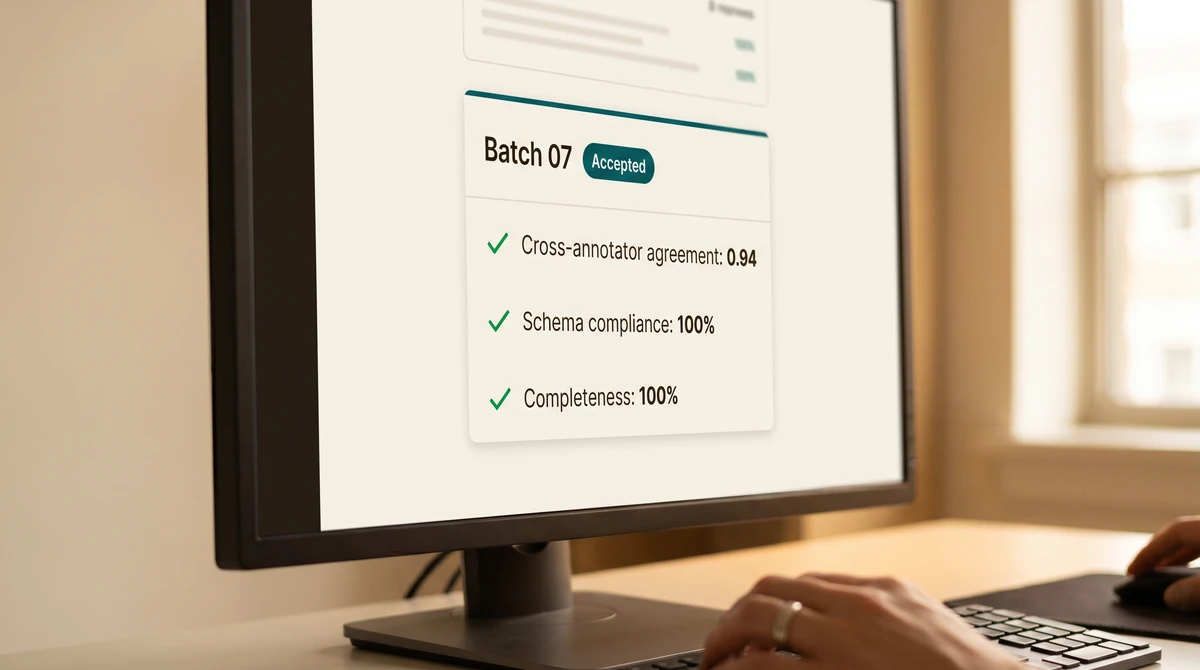
DD structures AI data engagements around a separation-of-roles principle at every stage: the person who annotates a record is not the person who reviews that record. Annotators self-check against schema guidelines; a senior reviewer samples the batch and checks cross-annotator consistency; the PM validates batch-level completeness and schema compliance before each release. That chain is documented, not verbal - and it applies at every delivery, not only the final one.
The request review review separates the work type before quoting. Annotation, evaluation, transcription, and dataset cleanup each carry different task rules, different output schemas, and different quality-check criteria. DD uses the task type, sample file, language list, and the quality check the buyer will apply to decide whether the returned data is acceptable - to separate these before accepting a project, not after reviewing the first batch.
Cross-annotator consistency is tracked on all annotation and evaluation projects. If annotators for the same language are applying label categories differently, that is flagged before the batch is released - not discovered when the training run produces unexpected behavior. Unclear examples, ambiguous label cases, and instruction edge cases are documented and returned with the batch, not silently forced into a label.
For AI data pipelines that deliver in rolling batches: DD can receive content incrementally and return processed output on a defined cadence. Batch-level quality metrics - completeness, schema compliance, cross-annotator consistency - are reported at each delivery, not accumulated and reported at project close. That gives data ops teams the signal they need to catch systematic issues early.
Human-only workflows are available where the engagement prohibits AI-assisted production. For projects where the training-data integrity requires full human annotation with no AI-assisted labeling, DD delivers that. AI policy is client-configurable at request review. For AI-assisted workflows, all AI output is reviewed by a human linguist before delivery.