
Key Takeaways
- Tools for multimedia localization toolexplanationuse casesubtitle editing softwareenables precise timing, formatting, and synchronization of subtitles across languagesmarketing videos, training modules, ott contentai translation enginesprovides fast initial translations for large volumes of multimedia scriptsbulk localization projectsvoiceover & dubbing platformsfacilitates multilingual audio production with native speakersadvertisements, films, e-learningvideo editing softwareallows modification of visuals, overlays, and timing for different marketsregional campaign customizationlocalization management systemscentralizes workflows, collaboration, and quality controlenterprise-scale localization operations multimedia localization uses in various industries multimedia localization has evolved into a critical function across industries where communication, engagement, and user experience directly influence outcomes.
- Pros: increases conversion rates and sales builds customer trust and confidence cons: requires constant updates for new products maintaining consistency across markets can be challenging across industries, multimedia localization transforms how content is perceived and consumed.
- Pros: improves learning outcomes and knowledge retention expands accessibility to global audiences cons: high cost for multi-language production requires frequent updates as content evolves entertainment the entertainment industry relies heavily on multimedia localization to distribute content globally.
- Pros: enables global distribution and audience expansion increases content discoverability and engagement cons: dubbing quality can affect viewer perception cultural nuances may still be partially lost gaming gaming represents one of the most complex applications of multimedia localization.
Introduction
Global brands in 2026 are operating in an environment where content travels faster than ever—but understanding does not. A single video campaign can reach millions across continents within hours, yet its impact depends entirely on how well it resonates locally. Audiences today expect more than translated captions; they expect content that reflects their language, culture, humor, and context. When brands fail to meet these expectations, even high-budget multimedia campaigns can fall flat.
At the same time, multimedia has become the dominant format for communication. From short-form videos and product explainers to interactive learning modules and immersive experiences, businesses rely heavily on multimedia to engage users. This shift has made multimedia localization a strategic necessity. It allows brands to maintain global consistency while delivering locally relevant experiences that drive engagement, trust, and revenue growth.
What is Multimedia?
Multimedia refers to the integration of multiple forms of content—text, audio, video, images, animation, and interactive elements—into a unified experience. Unlike traditional communication formats, multimedia engages users through multiple sensory channels at once. This layered approach improves comprehension, retention, and emotional connection. For example, a product demonstration video combines narration, visuals, motion graphics, and text overlays to explain complex features in seconds.
In modern business environments, multimedia extends far beyond marketing videos. It includes mobile applications, virtual training modules, augmented reality experiences, podcasts, webinars, and even customer support interfaces. The rise of platforms like streaming services and short-video apps has accelerated multimedia consumption globally. Reports indicate that video alone accounts for more than 80% of internet traffic, highlighting how central multimedia has become to digital communication strategies.
Another critical aspect of multimedia is interactivity. Users no longer passively consume content—they interact with it. Clicking, swiping, choosing, and responding are all part of the multimedia experience. This makes it more engaging but also more complex to design and deliver across diverse audiences. Businesses must ensure that every element works seamlessly together, which becomes even more challenging when scaling across multiple languages and regions.
What is Multimedia Localization?
Multimedia localization is the process of adapting multimedia content to suit the linguistic, cultural, technical, and contextual preferences of a specific target audience. It goes beyond translating text or subtitles. It involves modifying voiceovers, adjusting timing, redesigning visuals, adapting user interfaces, and ensuring that every component aligns with local expectations. The goal is to make the content feel as if it was originally created for that audience.
For example, a promotional video created for a Western audience might use humor, pacing, and cultural references that do not translate well in East Asian markets. Multimedia localization addresses this by rewriting scripts, changing visuals, and even altering storytelling styles to match local sensibilities. Similarly, colors, symbols, gestures, and music can carry different meanings across cultures, requiring careful adaptation.
This process is closely connected to audiovisual localization, video translation, and media localization, but it is broader in scope. It encompasses both content and user experience. In a mobile app, for instance, localization includes translating text, adjusting layouts for different languages, modifying icons, and ensuring that interactive elements function correctly. The complexity increases when dealing with large-scale global campaigns, where consistency and accuracy must be maintained across dozens of languages and formats.
Why is it Important for Businesses?
In 2026, the gap between localized and non-localized multimedia content is no longer subtle—it is measurable and significant. Recent global marketing reports indicate that localized video content can improve conversion rates by up to 80% and increase viewer retention by over 70% in non-English-speaking markets. This is not just a language preference; it reflects how deeply culture influences decision-making. When users feel that content speaks directly to them, they engage more, trust more, and ultimately buy more.
Multimedia localization plays a central role in bridging this gap. It ensures that every touchpoint—whether a product video, onboarding tutorial, or interactive ad—feels intuitive and relevant. For global brands and enterprises, this is not just about expanding reach; it is about maximizing the effectiveness of every piece of content across markets.
1. Increases Market Penetration
Entering a new market without localization is like launching a product without instructions. Users may see the content, but they do not fully understand it. Multimedia localization removes this barrier by making content immediately accessible.
For example, when global brands expand into multilingual markets like India or Southeast Asia, relying solely on English limits their reach to a fraction of the population. However, when the same campaigns are localized into regional languages with culturally relevant visuals, adoption rates increase significantly. This is particularly evident in mobile-first markets, where video content drives discovery.
2. Boosts Engagement Rates
Engagement is directly tied to relatability. Users are more likely to watch, interact with, and share content that reflects their language and culture. Localized subtitles, voiceovers, and visuals create a sense of familiarity that keeps audiences engaged longer.
Studies show that viewers are up to 2x more likely to complete a video when it is presented in their native language. This has a compounding effect—higher watch time improves algorithmic visibility on platforms, which further amplifies reach.
3. Improves Conversion Rates
Localization reduces cognitive effort. When users do not have to translate or interpret content mentally, they can focus on the value being presented. This clarity directly impacts decision-making.
For instance, localized product demonstration videos often lead to faster purchase decisions because users clearly understand features, benefits, and usage. In e-commerce, even small localization improvements—such as voiceover language or culturally relevant examples—can significantly increase conversion rates.
4. Strengthens Brand Trust
Trust is built when users feel understood. Multimedia localization signals that a brand respects and values its audience’s culture and language. This is especially important in regions where local identity strongly influences consumer behavior.
Brands that fail to localize often appear distant or generic. In contrast, those that invest in culturally aligned content are perceived as more authentic and reliable. Over time, this builds loyalty and long-term customer relationships.
5. Enhances User Experience
User experience is not just about design—it is about clarity and comfort. Multimedia localization ensures that instructions, navigation, and interactions are intuitive for local users.
In apps and platforms, this includes adapting UI elements, adjusting layouts for different languages, and ensuring that multimedia components function seamlessly. A well-localized experience reduces friction, increases satisfaction, and improves retention rates.
6. Enables Scalable Global Growth
For enterprises, scalability is key. Multimedia localization allows brands to reuse and adapt existing content across multiple markets instead of creating entirely new assets each time.
This approach maintains brand consistency while allowing for local customization. It also reduces costs in the long run and speeds up global expansion efforts. Companies that build localization into their workflows early are better positioned to scale efficiently.
Best Ways to Do Multimedia Localization
Multimedia localization is most effective when it is treated as a structured, strategic process rather than a last-minute adjustment. Businesses that integrate localization into their content lifecycle—from planning to execution—achieve better quality, faster turnaround times, and stronger results.
A well-executed localization strategy balances three critical elements: linguistic accuracy, cultural relevance, and technical precision. Ignoring any one of these can compromise the entire experience. For example, a perfectly translated script can still fail if the visuals or tone do not align with local expectations.
Below are the most effective practices for achieving high-quality multimedia localization:
- Plan Localization at the Content Creation Stage
Content should be designed with adaptability in mind. This includes using neutral visuals, avoiding culturally specific references unless necessary, and structuring scripts so they can be easily translated. Early planning reduces rework and ensures smoother localization workflows. - Collaborate with Native Linguists and Cultural Experts
Language alone is not enough—context matters. Native experts understand idioms, humor, and cultural sensitivities that automated systems often miss. Their input ensures that content feels natural and authentic rather than translated. - Use AI Strategically, Not Exclusively
AI tools can significantly speed up processes such as transcription and initial translation. However, they lack cultural nuance. Combining AI efficiency with human expertise creates a balance between speed and quality. - Adapt Visual and Audio Elements Thoroughly
Localization should extend beyond text. Background music, imagery, gestures, and even pacing may need adjustments. For example, color symbolism varies widely across cultures and can influence perception. - Test Localized Content in Real Markets
Testing is essential for optimization. Running A/B tests on localized versions helps identify what resonates best. Metrics such as engagement rate, watch time, and conversion rate provide valuable insights for refinement.
Tools for Multimedia Localization
| Tool | Explanation | Use Case |
| Subtitle Editing Software | Enables precise timing, formatting, and synchronization of subtitles across languages | Marketing videos, training modules, OTT content |
| AI Translation Engines | Provides fast initial translations for large volumes of multimedia scripts | Bulk localization projects |
| Voiceover & Dubbing Platforms | Facilitates multilingual audio production with native speakers | Advertisements, films, e-learning |
| Video Editing Software | Allows modification of visuals, overlays, and timing for different markets | Regional campaign customization |
| Localization Management Systems | Centralizes workflows, collaboration, and quality control | Enterprise-scale localization operations |
Multimedia Localization Uses in Various Industries
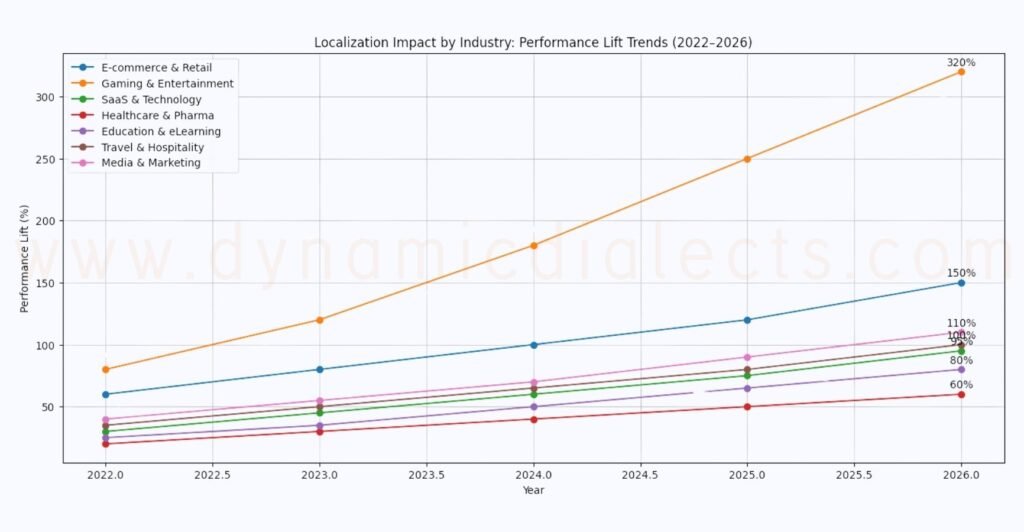
Multimedia localization has evolved into a critical function across industries where communication, engagement, and user experience directly influence outcomes. As multimedia content becomes the primary medium for delivering information—whether through video, interactive platforms, or audio—industries are increasingly relying on localization to bridge linguistic and cultural gaps.
What makes this particularly important in 2026 is the scale at which content is consumed globally. A single e-learning course, game, or product video can reach audiences in dozens of countries simultaneously. Without proper localization, this reach becomes ineffective. Industries that invest in multimedia localization not only expand their audience but also improve comprehension, retention, and conversion rates. The depth of localization varies by sector, but its impact is consistently measurable.
Industry Use Table
| Industry | Video Localization | Audio/Dubbing | UI Adaptation | Cultural Adaptation |
| E-learning | ✓ | ✓ | ✓ | ✓ |
| Entertainment | ✓ | ✓ | ✗ | ✓ |
| Gaming | ✓ | ✓ | ✓ | ✓ |
| Healthcare | ✓ | ✓ | ✓ | ✓ |
| E-commerce | ✓ | ✗ | ✓ | ✓ |
E-learning
E-learning is one of the most localization-dependent industries because its core objective is comprehension. Multimedia elements such as instructional videos, voiceovers, animations, and interactive quizzes must be fully understood by learners from different linguistic backgrounds. Localization ensures that learners do not just translate content mentally but absorb it naturally.
For example, global platforms often adapt not only the language of instruction but also examples, case studies, and even accents in voiceovers. A business course designed for U.S. learners may reference local companies or scenarios that do not resonate with learners in India or Germany. Localization replaces these with regionally relevant examples, making the learning experience more relatable and effective.
Research shows that learners are significantly more likely to complete courses when content is delivered in their native language. This directly impacts platform success metrics such as completion rates and user retention.
Pros:
- Improves learning outcomes and knowledge retention
- Expands accessibility to global audiences
Cons:
- High cost for multi-language production
- Requires frequent updates as content evolves
Entertainment
The entertainment industry relies heavily on multimedia localization to distribute content globally. Streaming platforms, film studios, and content creators use subtitles, dubbing, and cultural adaptation to make content accessible and engaging for international audiences.
A strong example is how global streaming platforms localize not just dialogue but also humor, idioms, and emotional tone. In some cases, scripts are adapted rather than directly translated to preserve the intended impact. Visual elements, such as on-screen text or culturally sensitive scenes, may also be modified to suit regional audiences.
Localization has directly contributed to the global success of non-English content. Shows and films produced in one country can achieve worldwide popularity when properly localized, demonstrating how localization can turn regional content into global phenomena.
Pros:
- Enables global distribution and audience expansion
- Increases content discoverability and engagement
Cons:
- Dubbing quality can affect viewer perception
- Cultural nuances may still be partially lost
Gaming
Gaming represents one of the most complex applications of multimedia localization. Unlike passive content, games are interactive experiences that require seamless integration of language, visuals, audio, and user interface elements. Localization in gaming goes far beyond translation—it includes adapting character dialogue, storylines, UI layouts, and even gameplay mechanics.
For example, certain symbols, gestures, or themes that are acceptable in one culture may need modification in another. Additionally, text expansion in different languages can affect UI design, requiring adjustments to maintain usability. Voice acting also plays a critical role, as it influences player immersion and emotional connection.
Successful localization can significantly impact a game’s global performance. Many top-performing games achieve the majority of their revenue from international markets, largely due to effective localization strategies that make players feel the game was designed specifically for them.
Pros:
- Enhances player immersion and engagement
- Drives global downloads and revenue growth
Cons:
- Highly resource-intensive and complex
- Requires continuous updates and maintenance
Healthcare
In healthcare, multimedia localization serves a critical and sensitive role. It is used in patient education videos, medical training modules, awareness campaigns, and digital health platforms. Unlike other industries, the margin for error here is extremely low—misinterpretation can have serious consequences.
Localized multimedia ensures that patients clearly understand medical instructions, procedures, and health information. For example, a surgical preparation video must be not only translated but also culturally adapted to ensure clarity and comfort for patients. Visuals, tone, and terminology all need careful consideration.
Healthcare organizations also use localized multimedia for training medical professionals across regions. This helps standardize knowledge while ensuring that local regulations and practices are respected.
Pros:
- Improves patient understanding and outcomes
- Reduces risk of miscommunication
Cons:
- Requires extremely high accuracy and compliance
- Subject to strict regulatory standards
E-commerce
E-commerce platforms rely on multimedia localization to influence purchasing decisions. Product videos, demonstrations, and interactive content play a major role in how customers evaluate products. Localization ensures that this content is persuasive and easy to understand for different audiences.
For instance, a product video may need different voiceovers, units of measurement, or usage scenarios depending on the region. Cultural preferences also influence how products are presented. A marketing approach that works in one country may not resonate in another without adaptation.
Localized multimedia content has been shown to significantly improve conversion rates. When customers feel confident in their understanding of a product, they are more likely to complete a purchase. This makes localization a key driver of revenue in global e-commerce operations.
Pros:
- Increases conversion rates and sales
- Builds customer trust and confidence
Cons:
- Requires constant updates for new products
- Maintaining consistency across markets can be challenging
Across industries, multimedia localization transforms how content is perceived and consumed. It turns generic global messaging into meaningful local experiences. Whether it is helping a student understand a lesson, enabling a viewer to connect with a story, immersing a gamer in a virtual world, guiding a patient through medical information, or convincing a customer to make a purchase—localization plays a decisive role.
As industries continue to digitize and expand globally, the importance of multimedia localization will only grow. Businesses that invest in deep, industry-specific localization strategies will not only reach wider audiences but also create stronger, more lasting connections with them.
Brands Using Multimedia Localization
Global brands have demonstrated that multimedia localization is not just a tactical tool—it is a growth engine. Their strategies provide clear, measurable examples of how localization impacts engagement, expansion, and revenue.
Netflix
Netflix has built one of the most advanced localization ecosystems in the world. It offers subtitles and dubbing in over 30 languages and invests heavily in culturally adapting content. This approach has enabled Netflix to generate more than 70% of its viewership from outside the United States.
Beyond language, Netflix localizes thumbnails, trailers, and even content recommendations based on regional preferences. For example, the same show may have different promotional visuals in different countries, tailored to what resonates locally. This level of personalization significantly improves click-through rates and viewer retention.

YouTube
YouTube serves as a global platform where localization directly influences content reach. Creators and brands that localize their videos—through subtitles, dubbing, and region-specific adaptations—often see exponential growth in international audiences.
Data shows that channels using multilingual strategies can increase their global viewership by 2–3 times within months. Brands leverage this by creating localized ad campaigns and content series that cater to specific markets, maximizing engagement and ROI.
Airbnb
Airbnb uses multimedia localization to create a seamless experience across more than 220 countries. Its platform includes localized videos, listings, and user interfaces tailored to different regions.
This strategy ensures that users feel comfortable navigating the platform and understanding offerings. By combining localization with storytelling, Airbnb builds trust and emotional connection, which is critical in the travel industry.
Duolingo
Duolingo integrates multimedia localization directly into its product. Lessons are designed with cultural context in mind, making them relatable and engaging for users worldwide.
This approach has contributed to Duolingo’s high retention rates and global popularity. By adapting content to local contexts, it ensures that learning feels intuitive and enjoyable rather than mechanical.
Amazon
Amazon localizes its multimedia content across global marketplaces, including product videos, advertisements, and UI elements. This strategy helps customers understand products better and make informed decisions.
Localized content plays a significant role in Amazon’s success in non-English markets, where clear and relatable product presentations drive higher conversions and customer satisfaction.
.Challenges in Multimedia Localization
As powerful as multimedia localization is, it comes with a layer of complexity that many businesses underestimate. Unlike text translation, multimedia involves multiple moving parts—audio, visuals, timing, user interfaces, and cultural context—all of which must align perfectly. When even one element fails, the entire experience can feel disjointed or inauthentic.
In 2026, the challenge is not just about localizing content—it is about doing it at scale, across multiple formats, and at speed. Global brands are producing massive volumes of multimedia content ежедневно, from short-form videos to interactive platforms. Managing this volume while maintaining quality, consistency, and cultural accuracy is where most organizations struggle. Below are the most critical challenges, along with practical solutions grounded in real-world workflows.
1. High Costs of Multimedia Production and Adaptation
Multimedia localization is resource-intensive. It requires translators, voice actors, video editors, sound engineers, QA specialists, and project managers. Unlike text localization, where changes are relatively straightforward, multimedia often requires re-editing entire segments, re-recording audio, and re-syncing visuals. This significantly increases production costs.
For example, dubbing a single marketing video into five languages can multiply costs several times over, especially when native voice actors and studio production are involved. Enterprises producing hundreds of videos per year face exponential cost scaling.
Solution:
Businesses should adopt a modular content strategy. By creating reusable templates, separating voice tracks from visuals, and designing flexible scripts, companies can localize efficiently without recreating assets from scratch. Prioritizing high-impact markets first also helps optimize ROI.
2. Cultural Misalignment and Context Loss
One of the most common and damaging challenges is cultural misalignment. Content that works perfectly in one region may feel irrelevant—or even offensive—in another. Humor, gestures, symbolism, and storytelling styles vary widely across cultures.
For instance, a gesture considered positive in one culture may carry a negative meaning elsewhere. Similarly, colors can evoke different emotions depending on the region. If these elements are not adapted, the content may fail to connect with the audience.
Solution:
Localization should involve in-market cultural consultants, not just translators. Brands should also conduct regional testing before full-scale launches. This ensures that content resonates emotionally and culturally, not just linguistically.
3. Technical Complexity Across Formats and Platforms
Multimedia content exists in various formats—videos, apps, games, interactive modules—and each comes with its own technical requirements. Synchronizing subtitles, aligning voiceovers, adjusting UI layouts, and maintaining compatibility across devices can be highly complex.
For example, languages like German or Spanish often require more space than English, which can disrupt UI layouts or subtitle timing. Similarly, right-to-left languages such as Arabic require complete interface restructuring.
Solution:
Using standardized localization tools and frameworks can reduce complexity. Localization management systems help centralize workflows, while adaptive design practices ensure that content can accommodate different languages and formats without breaking.
4. Time Constraints and Faster Go-to-Market Demands
In fast-moving industries, speed is critical. Marketing campaigns, product launches, and content releases often operate on tight deadlines. Localization, if treated as a final step, can delay these timelines significantly.
This challenge becomes more pronounced when multiple languages are involved. Coordinating teams, managing revisions, and ensuring quality across versions can slow down production cycles.
Solution:
The key is to integrate localization into the content creation process. Parallel workflows—where content creation and localization happen simultaneously—can drastically reduce turnaround times. Automation tools can further accelerate repetitive tasks like transcription and subtitle generation.
5. Maintaining Quality and Consistency Across Languages
Consistency is one of the hardest aspects of multimedia localization. When content is localized into multiple languages, variations in tone, terminology, and quality can emerge. This can dilute brand identity and create uneven user experiences.
For example, inconsistent voiceover styles or terminology across regions can make a brand feel fragmented rather than unified. This is especially problematic for global enterprises that rely on strong brand consistency.
Solution:
Implementing centralized quality assurance frameworks is essential. This includes maintaining glossaries, style guides, and brand voice guidelines for each language. Regular audits and feedback loops help ensure that quality remains consistent across all localized content.
6. Continuous Content Updates and Scalability Issues
Modern businesses produce content continuously. Product updates, new features, seasonal campaigns, and user-generated content all require ongoing localization. This creates a scalability challenge—keeping all localized versions up to date without overwhelming resources.
For example, an e-commerce platform with thousands of product videos must constantly update content as inventory changes. Without an efficient system, localization can quickly fall behind.
Solution:
Businesses should adopt a hybrid approach combining automation and human expertise. AI can handle repetitive updates and initial translations, while human reviewers ensure accuracy and cultural relevance. Building scalable workflows with clear version control also helps manage ongoing updates efficiently.
Conclusion
Multimedia localization has moved from being a supportive function to becoming a central pillar of global business strategy. As multimedia content continues to dominate how brands communicate, the ability to adapt that content for diverse audiences determines how effectively a company can scale internationally. It is no longer enough to translate words—brands must localize experiences, ensuring that every visual, sound, and interaction aligns with the expectations of the target audience. Those that invest in this process gain a measurable advantage in engagement, trust, and revenue.
For businesses looking to navigate this complexity with precision, partnering with experts makes a significant difference. Dynamic Dialects, a specialized linguistic service provider, helps brands deliver high-quality, culturally accurate multimedia localization at scale. If your goal is to connect with global audiences in a way that feels truly local, the right localization strategy—and the right partner—can make all the difference.