
Credentialed through NBCMI and CCHI, plus 40-hour training
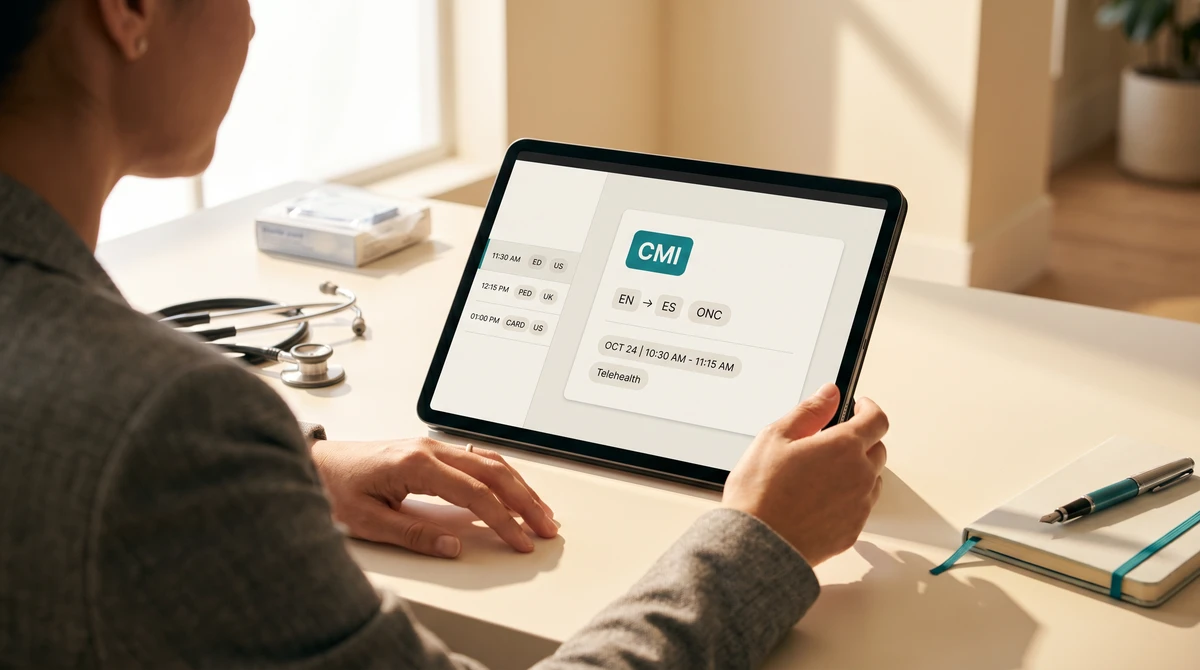
Medical interpreter services
Scope medical interpreter coverage with clinical setting, credentialing, and encounter type settled first.
Connect a clinician and a limited-English-proficient patient through a credentialed medical interpreter matched to the clinical setting with credential level, encounter type, modality, and recording policy confirmed in writing before the session starts.
Check interpreter availability
Short form: name, work email, language, date, time, setting, and modality.
Oncology, OB/GYN, pediatrics, behavioral health, ED, surgical, palliative, transplant, research
In-person on-site, video remote interpreting (VRI), and phone (OPI)
Code of Ethics and Standards of Practice followed in every encounter
Dynamic Dialects supports requests across 250+ languages with ISO 9001/27001 operating controls, ISO 17100 applied to translation scopes, 40,000+ vetted linguists, named project coordination, and written confirmation before production work begins.
Evidence for review
What DD can show before a buyer commits.
This is not a public case study claim. It is DD-owned evidence a buyer can request when the work needs vendor review before a scope is approved.
Ask for proof details- Buyer type
- Medical interpreter services event coordinator, court administrator, or healthcare scheduler checking language match, setting, modality, and qualification needs before session confirmation.
- Problem
- The buyer needs medical interpreter services scoped by language, setting, modality, participant needs, qualification requirements, and schedule before session confirmation.
- Scope
- Medical interpreter services work coordinated by DD with written request review, named PM ownership, and review records matched to the request type.
- Constraint
- This page cannot rely on a public case study yet; it must point to DD-owned proof artifacts and disclosure-safe process evidence.
- DD action
- DD confirms the inputs, missing details, staffing option, quality check, and delivery record before production work begins.
- Evidence available
- Private proof can include a request-specific checklist, redacted QA summary format, delivery record format, and sourcing or reviewer notes.
- Outcome
- The buyer can judge whether DD fits the requirement before sending production files or adding this service to a vendor shortlist.
- Disclosure status
- DD-owned proof only. Public outcomes require client approval; redacted process artifacts can be shared when terms allow.
How the work runs
-
Scope the program
Credential level (CMI or CHI), clinical setting, encounter type, language pair with regional variant, modality, and recording policy confirmed in writing first.
-
Match interpreter to setting
Interpreter assigned by clinical-setting familiarity (oncology, OB/GYN, behavioral health, ED, transplant, research) rather than generic medical interpreter rotated across unrelated specialties.
-
Review pre-encounter terminology
Pre-encounter terminology summary reviewed when the clinician supplies background notes. NCIHC Code of Ethics confidentiality observed.
-
Interpret the clinical encounter
Bedside, exam room, telehealth, or research subject visit interpretation. Sight translation of patient registration, consent, and discharge documents in scope when needed.
-
Deliver post-encounter summary
Post-encounter summary on request (attendance, duration, language pair, modality). Recurring availability for ongoing care relationships.
What DD checks before quoting
- Source file review Completeness, legibility, format, and any visible damage or quality issues.
- Pair confirmation Source → target language, variant, dialect, and script requirements.
- Purpose check Receiving office, certification or notarization need, and deadline driver.
- QA plan Review type, sample size, sign-off owner, and any client-specific checklist.
- Delivery format File type, naming convention, storage method, and handoff protocol.
- Risk note Known constraints, specialist availability, and contingency if timing shifts.
Example scope — actual checks vary by project type and client requirements.
Each medical interpreter engagement starts with a written specification confirming credential level (CMI through the National Board of Certification for Medical Interpreters or CHI through the Certification Commission for Healthcare Interpreters), clinical setting (oncology, OB/GYN, pediatrics, behavioral health and psychiatry, emergency department, surgical pre or post-op, palliative care, organ transplant coordination, infectious disease, clinical research site visit), encounter type (bedside, exam room, informed consent, discharge planning, telehealth visit, IRB-approved subject visit), language pair with regional variant, modality (in-person on-site, video remote interpreting, or phone interpreting per the clinical setting), and patient-privacy-controlled recording policy. Interpreters work to the NCIHC National Code of Ethics for Interpreters in Health Care and the NCIHC Standards of Practice, with a pre-encounter terminology summary reviewed when the clinician supplies background.
For interpreting work, DD checks setting, participants, qualification needs, access, and schedule before confirming the session.
What this page helps you send
- Bedside and exam room interpretation for routine clinical visits in any of 250+ languages.
- Oncology, OB/GYN, pediatrics, and behavioral health interpretation with subject-matter-familiar interpreters.
- Emergency department interpretation with rapid access for urgent and unscheduled encounters.
- Surgical pre-op and post-op consults, informed consent interpretation, and discharge planning sessions.
- Telehealth video visit interpretation integrated with the clinical platform the care team already uses.
- Clinical research site visit interpretation with IRB-approved interpreters and ICH-GCP-aligned interpretation for trial subject encounters.
- Behavioral health and psychiatry interpretation with interpreters trained in mental-health communication patterns.
- Sight translation of patient registration forms, consent forms, and discharge instructions during the encounter (medical interpreter scope).
What you receive
- Credentialed medical interpreter matched to the setting, encounter type, and language pair recorded in the agreed scope.
- Pre-encounter terminology summary reviewed when the clinician supplies background notes or a case summary.
- Sight translation of clinical documents during the session (patient registration forms, consent forms, discharge instructions) when in scope.
- Post-encounter summary on request (attendance, duration, language pair, modality) for billing or compliance records.
- Recurring availability commitment for ongoing care relationships with the same interpreter named when continuity matters.
Questions teams ask first
What credentials do medical interpreters hold?
Medical interpreters are credentialed through the National Board of Certification for Medical Interpreters (NBCMI) as Certified Medical Interpreter (CMI) and through the Certification Commission for Healthcare Interpreters (CCHI) as CoreCHI, CHI-Spanish, CHI-Arabic, or CHI-Mandarin. Both pathways require a minimum 40-hour medical interpreter training program, language proficiency verification, and a written and oral examination. The credential level requested is confirmed during the program scoping rather than assumed across all encounters.
Which clinical settings are covered?
Coverage spans oncology, OB/GYN and labor and delivery, pediatrics, behavioral health and psychiatry, emergency department, surgical pre-op and post-op consults, palliative care, organ transplant coordination, infectious disease, and clinical research site visits. The clinical setting is confirmed during scoping so the interpreter assigned has subject-matter familiarity for the encounter type, rather than a generic medical interpreter rotated across unrelated clinical contexts.
What is the NCIHC Code of Ethics and why does it matter?
The National Council on Interpreting in Health Care (NCIHC) maintains the National Code of Ethics for Interpreters in Health Care and the Standards of Practice. The Code covers confidentiality, accuracy, impartiality, respect, cultural awareness, role boundaries, professionalism, professional development, and advocacy. Medical interpreters work to both documents in every encounter, which gives the clinical team a predictable interpretation experience and gives the patient a consistent ethical floor regardless of the individual interpreter staffed.
How is in-person, video, and phone interpreting chosen for a clinical encounter?
In-person on-site interpreting fits high-acuity encounters where visual context matters (clinical assessments, mental-health assessment visits, complex consent, in-room family-member presence). Video remote interpreting (VRI) fits encounters where visual context matters but in-person is impractical (after-hours clinical assessments, signed-language access, rural sites). Phone interpreting (OPI) fits voice-only encounters where visual cues do not matter (appointment confirmation, simple care coordination calls, voice-only telehealth). The modality is confirmed per program scope rather than promised generically.
Is clinical research site interpretation supported?
Yes. Clinical research subject visit interpretation is staffed by interpreters with IRB approval at the site and ICH-GCP-aligned interpretation practice for trial subject encounters. Informed consent interpretation, screening visit interpretation, follow-up visit interpretation, and unscheduled adverse-event interpretation are scoped per protocol. Sponsor-imposed language requirements (interpreter qualification expectations beyond CMI or CHI) are recorded in the program scope before the first subject visit.
How is patient privacy and recording handled?
The default for medical interpreting is no recording. Recording is enabled only when the clinical setting and the patient explicitly require it (training, QA, or compliance reasons) and the patient is informed at the start of the session. Patient health information stays controlled per the care team's privacy program and the interpreter's NCIHC Code of Ethics confidentiality requirement. The recording policy is captured in the program scoping rather than left ambiguous per encounter.
How are sight translation of clinical documents handled during an encounter?
Sight translation of patient registration forms, consent forms, medication lists, and discharge instructions during a session is in scope for medical interpreters at the CMI or CHI credential level. The interpreter reads the source document and delivers the equivalent target-language version verbally to the patient with clinician oversight. For document translation that needs to stay with the patient or the medical record, written medical document translation is scoped separately rather than handled as sight translation.
What about rare-language and refugee-resettlement coverage?
Coverage spans 250+ languages including rare and refugee-resettlement pairs where most healthcare interpreting platforms cannot source a qualified interpreter on demand. For ultra-rare pairs, the available time windows for a credentialed medical interpreter are confirmed during program scoping so the care team knows when coverage is guaranteed versus when a fallback (scheduled callback, written sight translation, video remote interpreting in a sibling language pair) applies.