
Coverage reviewed per request, includes ASL
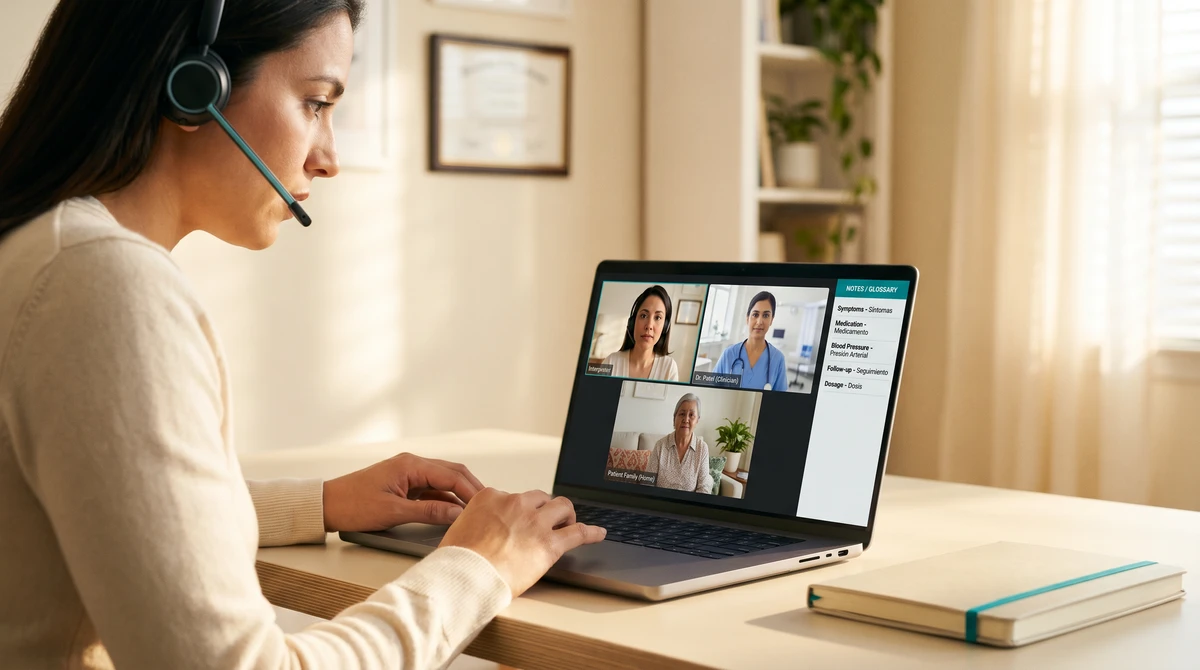
Video remote interpreting
Scope video remote interpreting with platform, language, and visual setup confirmed first.
Bring an interpreter into a video session with the platform, language, qualification expectation, camera framing, and privacy controls settled in writing before the call begins.
Check interpreter availability
Short form: name, work email, language, date, time, setting, and modality.
Clinical, legal, educational, customer service, public sector
Scheduled sessions confirmed; on-demand scoped per program
Signed-language access via VRI included
Dynamic Dialects supports requests across 250+ languages with ISO 9001/27001 operating controls, ISO 17100 applied to translation scopes, 40,000+ vetted linguists, named project coordination, and written confirmation before production work begins.
Evidence for review
What DD can show before a buyer commits.
This is not a public case study claim. It is DD-owned evidence a buyer can request when the work needs vendor review before a scope is approved.
Ask for proof details- Buyer type
- Video remote interpreting event coordinator, court administrator, or healthcare scheduler checking language match, setting, modality, and qualification needs before session confirmation.
- Problem
- The buyer needs scope video remote interpreting with platform, language, and visual setup confirmed first. scoped by language, setting, modality, participant needs, qualification requirements, and schedule before session confirmation.
- Scope
- Video remote interpreting work coordinated by DD with written request review, named PM ownership, and review records matched to the request type.
- Constraint
- This page cannot rely on a public case study yet; it must point to DD-owned proof artifacts and disclosure-safe process evidence.
- DD action
- DD confirms the inputs, missing details, staffing option, quality check, and delivery record before production work begins.
- Evidence available
- Private proof can include a request-specific checklist, redacted QA summary format, delivery record format, and sourcing or reviewer notes.
- Outcome
- The buyer can judge whether DD fits the requirement before sending production files or adding this service to a vendor shortlist.
- Disclosure status
- DD-owned proof only. Public outcomes require client approval; redacted process artifacts can be shared when terms allow.
How the work runs
-
Confirm scope
Language pair (including ASL), platform, session type, interpreter qualification, and privacy controls recorded in writing first.
-
Match an interpreter to the session
Healthcare interpreter for clinical sessions, legal interpreter for legal sessions, ASL interpreter for signed-language access.
-
Set up the visual signal
Interpreter joins from a quiet space with neutral background, good lighting, and a tested headset so the participant on the other end hears clearly the first time.
-
Interpret the session
Consecutive or simultaneous mode confirmed at the start; sessions are not recorded by default; technical fallback expectations agreed up front.
-
Confirm and close
Post-session summary on request (attendance, duration, language pair) for billing or compliance records; recurring sessions scheduled with continuity where it matters.
What DD checks before quoting
- Source file review Completeness, legibility, format, and any visible damage or quality issues.
- Pair confirmation Source → target language, variant, dialect, and script requirements.
- Purpose check Receiving office, certification or notarization need, and deadline driver.
- QA plan Review type, sample size, sign-off owner, and any client-specific checklist.
- Delivery format File type, naming convention, storage method, and handoff protocol.
- Risk note Known constraints, specialist availability, and contingency if timing shifts.
Example scope — actual checks vary by project type and client requirements.
Each VRI request starts with a written request check confirming language pair (including ASL), platform (Zoom, Teams, Google Meet, dedicated VRI platform, or your own browser-based tool), session type (clinical, legal, educational, customer service), interpreter qualification expectation, scheduled vs on-demand cadence, and privacy scope. Interpreters join from a quiet space with a neutral background, good lighting, and a tested headset so the participant on the other end of the call hears clearly the first time. Standard scheduled VRI sessions are confirmed in writing with interpreter name and start time; on-demand availability for high-volume programs is scoped per program rather than promised generically.
For interpreting work, DD checks setting, participants, qualification needs, access, and schedule before confirming the session.
What this page helps you send
- Healthcare appointments, telehealth visits, and care coordination calls.
- Legal sessions (attorney-client meetings, deposition prep, hearing prep) with qualification needs confirmed.
- Educational meetings (IEP, parent-teacher, special education) with family-facing language access.
- Customer service and call center coverage for spoken-language and ASL users.
- Public sector and government program meetings with language-access compliance.
- Insurance claim interviews and benefits coordination calls.
- Multi-participant video sessions where camera framing, screen sharing, and chat handling matter.
- ASL and signed-language access via VRI with camera and lighting setup confirmed.
What you receive
- Confirmed interpreter name and start time, with platform meeting link or join instructions shared in advance.
- Interpreter joins from a quiet space with neutral background and a tested headset under front-facing light.
- Session interpretation in the requested language pair, with consecutive or simultaneous mode confirmed at start.
- Post-session summary on request (attendance, duration, language pair) for billing or compliance records.
- Recurring schedule support for ongoing programs, with the same interpreter named when continuity matters.
Questions teams ask first
What platforms is VRI supported on?
Zoom, Microsoft Teams, Google Meet, dedicated VRI platforms (Stratus, AMN, Language Line VRI), and browser-based tools your team already uses. The platform is confirmed in the request check so the interpreter joins through the same flow as everyone else; no separate dial-in dance.
Is ASL included via VRI?
Yes. ASL interpreters work over video remote when the participant has access to a camera-capable device with adequate lighting and a stable connection. Camera framing (shoulders and hands visible), lighting (front-facing, not back-lit), and background (plain) are confirmed at session start so the visual signal is clear. For settings where signing is not a fit (very loud environments, low-bandwidth connections), on-site interpreting is the alternative.
What about scheduled vs on-demand?
Scheduled sessions are confirmed in writing with interpreter name and start time. On-demand staffing (interpreter joins within a target window without a pre-set time) is scoped per program rather than promised generically because availability varies by language pair, session type, and time of day. Programs that need true on-demand at scale are quoted with a confirmed availability commitment per language.
How is interpreter qualification confirmed for clinical and legal sessions?
Clinical sessions are staffed by interpreters with healthcare interpreting credentials (CMI or CHI where applicable) and subject-matter familiarity for the appointment type. Legal sessions are staffed by interpreters with court or legal interpreting credentials and confidentiality controls. Qualification expectations are reviewed during the request check rather than assumed.
How is privacy handled during the session?
Interpreters work from a quiet space with no one else present and a closed door, sign NDAs for sensitive matters on request, and do not record sessions. For sessions containing protected health information, privacy-controlled handling applies (access-restricted joining, named-interpreter staffing, no recording or training-data use). Specific privacy terms can be aligned with your covered-entity requirements on request.
What if a session needs to switch from VRI to on-site mid-program?
Switching modes is common for ongoing programs (start with on-demand VRI for routine appointments, schedule on-site interpreter for sensitive or multi-party sessions). The mode for each session is set during the request check rather than locked in at program start, and the same interpreter can be staffed across modes when continuity matters.
How are technical issues handled during a session?
If audio or video quality drops during a session, the interpreter is asked to pause, request reconnection, and resume from the last clean exchange rather than guess through static. For high-stakes sessions, a fallback phone-in number is included so the session can continue without losing context. Technical fallback expectations are confirmed at the start of the session.
Is VRI available for languages other than the most common ones?
Yes. Coverage spans 250+ languages including rare and refugee-resettlement languages where most VRI platforms cannot source qualified interpreters. For ultra-rare languages, the available time windows for a qualified interpreter are confirmed during the request check rather than promised generically.