
Coverage reviewed per program, includes rare pairs
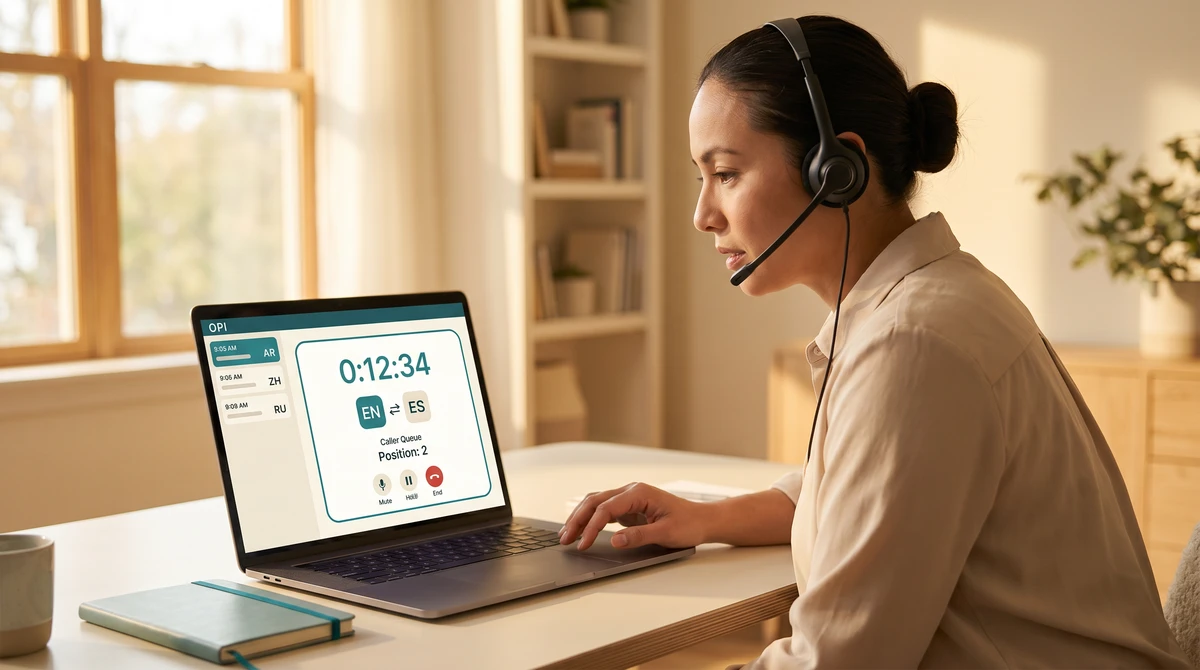
Phone interpreter services
Scope phone interpreter services with language, qualification, and call setup settled first.
Connect a phone caller with a qualified interpreter in the requested language with qualification expectation, session type, and connection setup confirmed in writing before the program runs live.
Check interpreter availability
Short form: name, work email, language, date, time, setting, and modality.
Clinical, legal, customer service, public sector, insurance
Scheduled sessions confirmed; on-demand windowed per program
Call-center connection and conference-bridge setup supported
Dynamic Dialects supports requests across 250+ languages with ISO 9001/27001 operating controls, ISO 17100 applied to translation scopes, 40,000+ vetted linguists, named project coordination, and written confirmation before production work begins.
Evidence for review
What DD can show before a buyer commits.
This is not a public case study claim. It is DD-owned evidence a buyer can request when the work needs vendor review before a scope is approved.
Ask for proof details- Buyer type
- Phone interpreter services event coordinator, court administrator, or healthcare scheduler checking language match, setting, modality, and qualification needs before session confirmation.
- Problem
- The buyer needs scope phone interpreter services with language, qualification, and call setup settled first. scoped by language, setting, modality, participant needs, qualification requirements, and schedule before session confirmation.
- Scope
- Phone interpreter services work coordinated by DD with written request review, named PM ownership, and review records matched to the request type.
- Constraint
- This page cannot rely on a public case study yet; it must point to DD-owned proof artifacts and disclosure-safe process evidence.
- DD action
- DD confirms the inputs, missing details, staffing option, quality check, and delivery record before production work begins.
- Evidence available
- Private proof can include a request-specific checklist, redacted QA summary format, delivery record format, and sourcing or reviewer notes.
- Outcome
- The buyer can judge whether DD fits the requirement before sending production files or adding this service to a vendor shortlist.
- Disclosure status
- DD-owned proof only. Public outcomes require client approval; redacted process artifacts can be shared when terms allow.
How the work runs
-
Scope the program
Language coverage, session types, qualification expectations, scheduled vs on-demand cadence, recording policy, and connection setup recorded in writing first.
-
Wire up the platform
Direct dial, conference bridge, or IVR integration tested against the contact-center or healthcare telephony stack the call team already uses.
-
Match interpreters to call types
Healthcare-credentialed interpreters for clinical calls, legal-qualified for legal, customer-service trained for support and public-sector lines.
-
Run the program
Scheduled sessions confirmed in writing with interpreter name and start time. On-demand connection within the target window per language pair.
-
Confirm and close
Post-session summary on request (attendance, duration, language pair) for billing or compliance, with recording policy honored per program.
What DD checks before quoting
- Source file review Completeness, legibility, format, and any visible damage or quality issues.
- Pair confirmation Source → target language, variant, dialect, and script requirements.
- Purpose check Receiving office, certification or notarization need, and deadline driver.
- QA plan Review type, sample size, sign-off owner, and any client-specific checklist.
- Delivery format File type, naming convention, storage method, and handoff protocol.
- Risk note Known constraints, specialist availability, and contingency if timing shifts.
Example scope — actual checks vary by project type and client requirements.
Each phone interpreting program starts with a written request check confirming language coverage (including rare and refugee-resettlement pairs), session type (clinical, legal, customer service, public sector), interpreter qualification expectation, scheduled vs on-demand cadence, recording policy, and connection setup (direct dial, conference bridge, IVR integration). Interpreters work from a quiet space with a tested headset so the participant on the other end of the call hears clearly the first time. Standard scheduled phone sessions are confirmed in writing with interpreter name and start time; on-demand availability for high-volume call centers is scoped per program with a target connection window per language rather than promised generically.
For interpreting work, DD checks setting, participants, qualification needs, access, and schedule before confirming the session.
What this page helps you send
- Healthcare phone interpreting for appointments, telehealth voice calls, discharge confirmation, and care coordination.
- Customer service and call-center coverage in spoken languages where in-language agents are not available.
- Legal phone interpreting for client calls, hearing prep, and administrative interviews with qualification verified.
- Public sector and government phone lines (211, 311, benefits enrollment, language-access compliance).
- Insurance phone interviews, claim coordination, and benefits explanation calls.
- Banking and financial-services phone support with sensitive-information handling controls.
- Rare-language phone coverage where most marketplaces cannot source a qualified interpreter on demand.
- Recurring high-volume programs running with a target connection window per language pair.
What you receive
- Connected interpreter session in the requested language with qualification expectation met.
- Connection integration ready for direct dial, conference bridge, or IVR handoff per the agreed setup.
- Post-session summary on request (attendance, duration, language pair) for billing or compliance records.
- Recurring availability commitment per language for ongoing programs, with the same interpreter named when continuity matters.
- Recording policy honored per program (default no-recording, opt-in only when the program explicitly requires it).
Questions teams ask first
When is phone interpreting the right fit vs video or on-site?
Phone interpreting is the fastest way to handle short voice-only calls where visual cues do not matter (customer service, simple appointment confirmation, voice-only telehealth, public-sector phone lines). Use video remote interpreting (VRI) when visual cues matter (clinical assessments, signed-language access, multi-party meetings). Use on-site interpretation for sensitive in-person sessions where room context and document handling matter (depositions, hospital admissions, in-person assessments).
How is on-demand availability handled?
On-demand programs are scoped per language with a target connection window per pair, rather than a single promise across all languages. Common spoken languages typically connect within a tight window during business hours; rare and refugee-resettlement languages have a wider window because the available interpreter pool is smaller. The target window is recorded in writing as part of the program scope.
Is around-the-clock availability supported?
Yes for common languages. Around-the-clock availability is scoped per language pair because rare-language interpreters are not always reachable at night in every time zone. For high-volume healthcare hotlines, customer service phone lines, and emergency services, the night-hours coverage commitment is recorded in writing per language so the program team knows exactly what to expect.
How is the call connected?
Three setups are common: direct dial (the agent or caller dials a number that connects to an interpreter), conference bridge (the agent dials the interpreter into an existing call), and IVR integration (the caller selects a language and the system connects to a qualified interpreter automatically). The setup is confirmed during the program scoping so the connection fits the platform the call team already uses.
How is interpreter qualification confirmed for clinical calls?
Clinical phone calls are staffed by interpreters with healthcare-interpreting credentials (CMI or CHI where applicable) and subject-matter familiarity for the call type. The qualification expectation is reviewed during the program scoping rather than assumed. For ad-hoc clinical phone needs without a scoped program, qualification is verified at the time of the request.
How is recording handled?
The default for phone interpreting is no recording. Recording is enabled only when the program explicitly requires it for compliance, training, or QA reasons and the participants are informed at the start of the session. Recording opt-in vs opt-out is captured in the program scoping rather than left ambiguous.
What about rare-language phone coverage?
Coverage spans 250+ languages including rare and refugee-resettlement languages where most call-center interpreting platforms cannot source a qualified interpreter on demand. For ultra-rare languages, the available time windows for a qualified interpreter are confirmed during program scoping so the call team knows when coverage is guaranteed vs when a fallback (email-based written interpretation, scheduled callback) applies.
Can phone interpreting integrate with our existing platform?
Yes. Direct integration with common contact-center platforms (Genesys, Five9, Amazon Connect, NICE CXone, Twilio Flex), healthcare telephony (Cisco UC, RingCentral Healthcare, Updox), and custom IVR setups is supported. The integration approach is confirmed during the program scoping and tested against the target platform before going live.