Need a certified translation? USCIS · legal · medical · academic (407) 537-2522 Get a quote →
AI data & language services Quote Request a scope
Solution · Subtitling and captioning

Ship subtitle and caption files that hold up in review and on platform.

Timed text fails in visible ways: line breaks that feel wrong, reading speed too fast for the audience, speaker labels that drop out, SDH cues that do not match the dialogue, or a platform that rejects the file format entirely. DD treats multimedia as a production discipline - not a translation request with timecodes added at the end.

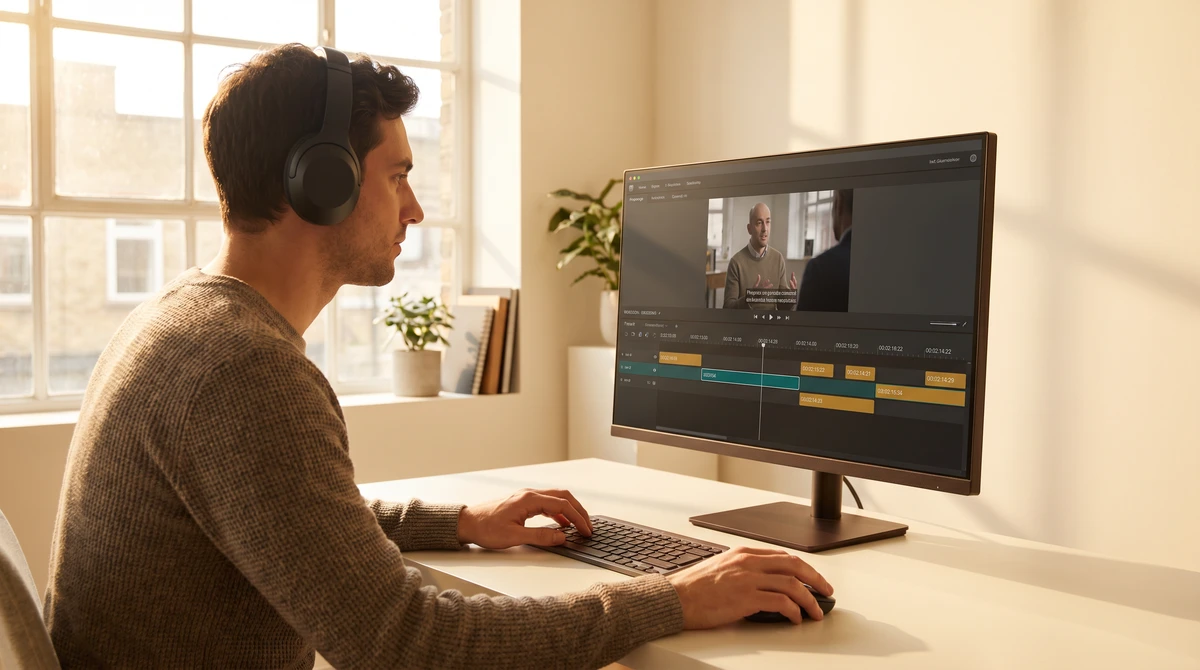
A media production workspace with a subtitling timeline on screen
200+ Subtitling & dubbing languages
3,000+ Voice talents
100+ Studio partners
1 Named PM per production
Evidence for review

What DD can show before a buyer commits.

This is not a public case study claim. It is DD-owned evidence a buyer can request when the work needs vendor review before a scope is approved.

Ask for proof details
Buyer type
Subtitling and captioning buyer, program owner, or language-company operations lead qualifying DD before sending production files.
Problem
The buyer needs subtitling and captioning scoped by work type, languages, inputs, deadline, and review process before a quote is accepted.
Scope
Subtitling and captioning across DD language operations with named PM coordination, independent review where applicable, and written scope confirmation.
Constraint
No public DD case study is cleared for this service yet, so proof must use DD-owned process artifacts instead of borrowed claims.
DD action
DD confirms the subtitling and captioning scope, assigns the PM contact, separates production from review where relevant, and returns written next steps.
Evidence available
Private proof can include a service start checklist, redacted QA summary format, delivery record format, and sourcing or staffing notes.
Outcome
The buyer can validate fit and operating discipline before sending production files or adding DD to a vendor roster.
Disclosure status
DD-owned proof only. Public client outcomes require approval; redacted process artifacts can be shared when disclosure terms allow.

How DD checks it

What enterprise buyers need from subtitling and captioning — and how DD delivers it.

DD coordinates subtitling, captioning, SDH, audio description, dubbing scripts, and voice-over production across 200+ languages through a network of 3,000+ voice talents and 100+ studio partners. The request is scoped by platform, runtime, source language, target languages, caption type, file format, and accessibility requirements - before production starts, not during review.

Watchability is the production standard, not word-for-word accuracy of the source. DD checks timing against reading speed for the target audience, line length against platform spec, speaker attribution against the audio, and sound cues and music flags for SDH files. A subtitle file that is linguistically correct but fails on any of these is not a deliverable.

For voice-over and dubbing: the 3,000+ voice talent pool is matched against language, register, demographic target, and any character or brand-voice specification. Studio partners are matched against the target language and the technical spec for the receiving platform. Sprint delivery is available for episodic series and catalog localization runs - one request covering the full batch, one PM across all episodes.

Accessibility formats are treated as first-class outputs, not add-ons. SDH files include dialogue, speaker labels, sound cues, and music flags. Audio description scripts follow timed narration requirements and platform accessibility standards. Delivery can include multiple formats simultaneously - SRT and VTT and SDH from one production run, organized for upload to the receiving system.

For language company and media operator under your brand programs: DD delivers under your brand. The PM, linguist chain, studio coordination, and file delivery all operate under your presentation requirements. End clients see your platform; DD's involvement is not disclosed. Ongoing series can be scoped as a capacity arrangement - not only episode-by-episode.

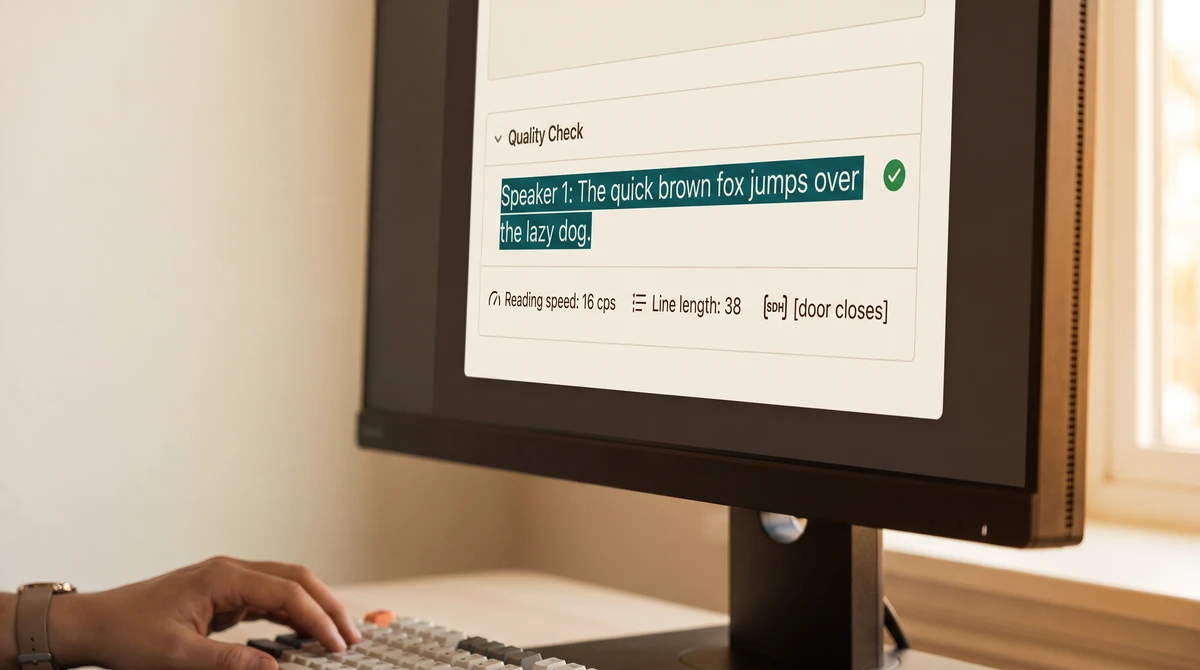
In the tool

Reading speed, line length, and SDH sound cues checked against platform spec — not just translation accuracy.

A close-up of a subtitle quality-check panel showing one caption line with reading speed, line length, and an SDH sound cue, marked as passed

Step by step

  1. Send the asset and scope

    Submit the media file or a sample, runtime, target languages, platform, caption type (subtitle, SDH, audio description, dubbing), and file format requirements.

  2. Production plan confirmed in writing

    DD reviews the platform spec, accessibility requirements, and voice or studio needs. A named PM is assigned. Timeline and production approach are confirmed before work begins.

  3. Production with watchability checks

    Timing is checked against reading speed, line length against platform spec, speaker attribution against the audio, and sound cues and music flags for SDH. A linguistically accurate file that fails these checks is not released.

  4. Delivery in the formats you need

    Multiple output formats (SRT, VTT, SDH) can be delivered from one production run, organized for upload to the receiving system or platform.

Quality and delivery

What buying teams need. What DD structures every engagement around.

Watchability, not just accuracy

DD checks timing against reading speed, line length against platform spec, speaker attribution against the audio, and sound cues and music flags for SDH. A subtitle file that is linguistically correct but fails on these criteria is not released.

One named PM per production

From request receipt through file delivery: script review, talent matching, studio coordination, timing check, and format packaging. One contact for status, scope changes, and platform-specific requirements.

200+ languages, 3,000+ voice talents, 100+ studio partners

Voice talent and studio partner matching covers language, register, demographic target, and technical spec for the receiving platform. Rare-language studio capacity is confirmed at request review before production is scheduled.

Sprint delivery for episodic and catalog programs

Series and catalog localization runs can be scoped as a sprint — one request covering the full batch, one PM across all episodes. Rolling delivery as content is ready, not waiting for the complete catalog.

Quality-management controls Information-security controls Translation-review controls Independent certification held for all three control areas

Quality stages

  • Script review and platform spec

    The script, platform format requirements, line-length limits, reading-speed target, and accessibility flags (SDH cues, speaker labels) are confirmed before production opens.

  • Linguistic translation and adaptation

    A qualified linguist adapts the source text for the target language, observing timing, condensation for reading speed, and cultural localization requirements.

  • Timing and readability check

    A separate review confirms timing against the audio, line breaks, reading speed for the audience, speaker attribution, and sound-cue completeness for SDH files.

  • Format packaging and delivery

    Files are exported in the required format(s) and verified for encoding, platform compatibility, and completeness before delivery.

Where this helps

Use this service when the stakes are clear.

  • Subtitling and captioning for training, marketing, streaming, and public service media
  • SDH captions with speaker labels, sound cues, and music flags for accessibility compliance
  • Audio description scripts for timed narration and platform accessibility requirements
  • Voice-over and dubbing across 200+ languages through vetted studio partners
  • Sprint delivery for episodic series and catalog localization programs
What to send first

Four details start the scope.

  1. Video or audio asset and runtime
  2. Target languages and platform or delivery system
  3. Caption type - subtitle, SDH, audio description, dubbing
  4. File format requirements and any accessibility or accessibility-compliance notes
Upload files for a scope

Send the media asset or a sample, runtime, target languages, platform, and caption type. DD returns scope, PM assignment, and timeline in writing before production begins.


Questions

Common questions before sending project details.

What file formats does DD deliver for subtitles and captions?

DD delivers SRT, VTT, SDH, subtitle, and caption files. The receiving platform matters because line length, timing, speaker attribution, encoding, accessibility standards, and upload requirements differ by system.

What does DD check for timing and readability?

DD checks reading speed against the target audience, line length against platform spec, speaker attribution against the audio track, and sound cues and music flags for SDH files.

Can DD deliver SDH captions with full accessibility content?

Yes. SDH files include dialogue, speaker labels, sound cues, and music flags. Audio description scripts follow timed narration requirements and platform accessibility standards.

How does voice-over and dubbing work across languages?

DD draws on 3,000+ voice talents and 100+ studio partners. The match covers language, register, demographic target, and any character or brand-voice specification.

Is sprint delivery available for episodic or catalog programs?

Yes. Episodic series and catalog localization runs can be scoped as a sprint - one request covering the full batch, one PM across all episodes or titles.

Can DD translate or adapt existing subtitle files?

Yes. Existing SRT, VTT, or subtitle files can be translated or adapted. Send the source timed-text file, video reference, target languages, platform requirements, and timing constraints.


Related

Keep moving from the same request.

Dynamic Dialects 200 E Robinson Street, Suite 1120-H16 Orlando, FL 32801 (407) 537-2522 info@dynamicdialects.com Mon-Fri | 8a-7p ET
Send the requirement

Get the right scope in writing.

Share the language pair, file type, audience, or problem. DD replies with availability, open questions, handling notes, and the next step before work starts.

Four fields are enough to start. Add files later if handling needs review.