Need a certified translation? USCIS · legal · medical · academic (407) 537-2522 Get a quote →
AI data & language services Quote Request a scope
Industry · Education

Cover education language work so it reaches the learner.

Education language work sits at the intersection of access and accountability. A family notice that does not reflect the district's actual information creates confusion rather than engagement. An academic record translated for admissions that arrives in the wrong format delays the evaluation. A course video captioned without attention to reading speed and speaker attribution fails students who rely on it for access. DD structures education language engagement around the learner and the institutional context — not the file name or the language pair.

An education language specialist captioning an eLearning module in a bright workspace
250+ Languages
40,000+ Vetted linguists
Quality controls Documented review chain
1 Named PM per engagement
Evidence for review

What DD can show before a buyer commits.

This is not a public case study claim. It is DD-owned evidence a buyer can request when the work needs vendor review before a scope is approved.

Ask for proof details
Buyer type
Education buyer, compliance owner, program lead, or vendor manager qualifying a regulated language supplier.
Problem
The buyer needs education language work scoped with the setting, audience, access controls, and review process confirmed before commitment.
Scope
Education work across files, sessions, media, or data tasks where privacy, recipient requirements, and audit expectations matter.
Constraint
Regulated buyers need proof without public client disclosure; DD cannot publish client-specific outcomes unless the client clears them.
DD action
DD confirms the education use case, content handling, role-scoped access, review chain, and missing inputs before production.
Evidence available
Private proof can include a redacted request checklist, access-control checklist, QA summary format, and delivery record format for the relevant setting.
Outcome
The buyer can verify whether DD can handle the setting before sharing sensitive content or scheduling the engagement.
Disclosure status
DD-owned proof only. Public client outcomes require approval; redacted process artifacts can be shared when disclosure terms allow.

How DD checks it

What enterprise buyers need from education — and how DD delivers it.

DD confirms the audience type, the institutional setting, the language pair, the format requirement, and who reviews the output before production starts. K-12 family communication, higher education admissions documents, professional development content, accessibility compliance materials, and international student support each require a different register, format, and review chain. DD separates those before production opens.

K-12 family communication requires plain-language translation in the community language, not a standardized dialect or a register calibrated for an adult professional reader. A school enrollment form, a parent handbook, an emergency notification, a behavior plan, and a home-language survey each carry different urgency levels, different reading-level requirements, and different format standards. DD confirms the audience, the institutional context, and the review owner before the project opens. For districts with multi-language family populations, multi-language programs run under a single PM and single contract.

Higher education presents a distinct set of language requirements: academic record translation for admissions, certified transcript services, international student support materials, multilingual financial aid documentation, and faculty-facing research content. For credential evaluation submissions, DD reviews the receiving evaluator's requirements covering format, certification wording, document type, and any institution-specific layout standards, before accepting the project. For international student-facing materials, register and audience level are confirmed at the start.

Accessible media for educational institutions requires production-discipline attention, not a text overlay. Course videos, lecture recordings, professional development modules, and online learning content need SDH captions that reflect reading speed, speaker attribution, and sound cues, not just a transcript pasted over the timeline. Audio description for visual content must follow the timed narration structure the platform requires. For ed-tech teams launching multilingual courses, DD can scope subtitling, captioning, dubbing, and voice-over in a single sprint.

Training content and professional development materials require tone and register alignment with the institutional audience: K-12 teachers, university staff, corporate learning-and-development teams, and compliance training recipients each expect a different reading register. DD confirms the audience and the institutional context, not just the language pair, before the training content is localized. For eLearning platforms with text-on-screen requirements, character expansion and UI space constraints are reviewed at the start, not at delivery.


In the tool

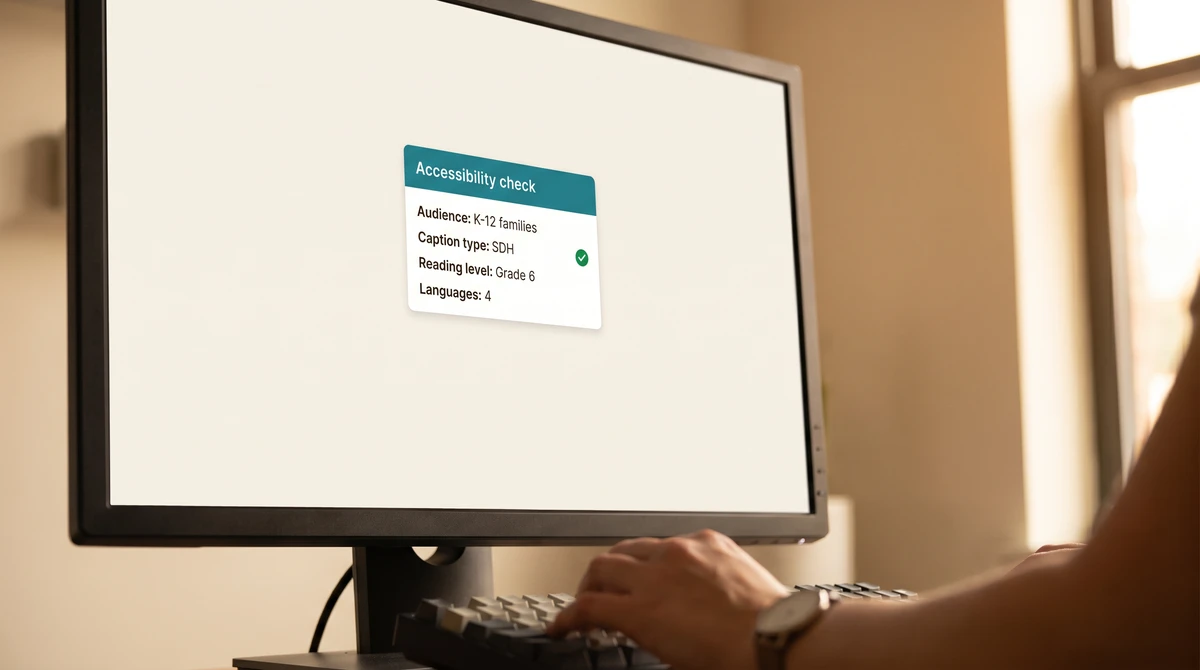
Audience, caption type, and reading level confirmed up front — accessible media treated as a production discipline.

A close-up of an education accessibility check card showing audience, SDH caption type, reading level, and language count

Step by step

  1. Name the institution type and audience

    Share the institution type (K-12 district, university, ed-tech platform), the learner or family audience, language pair, file or session type, any format or accessibility requirement, and the review owner.

  2. Register and format confirmed for the audience

    For K-12 family communication: community language variety, reading level, and district format are confirmed. For academic records: receiving evaluator requirements and certification wording are reviewed. For accessible media: platform spec, reading speed, and SDH requirements are confirmed before production.

  3. Production with independent review

    The production linguist and the reviewer are always separate people. For multi-language programs (district-wide family communication, multilingual course localization), all pairs run under a single PM and single contract.

  4. Delivery confirmed against institutional requirements

    QA documentation is available on request — relevant for district compliance reviews and accreditation requirements. For accessible media, multiple formats (SRT, VTT, SDH) can be delivered from one production run.

Quality and delivery

What buying teams need. What DD structures every engagement around.

Audience and register confirmed before production

DD confirms the institutional type and the learner or family audience before production begins. K-12 family communication, higher education admissions, accessibility content, and professional development each require a different register and review chain. The right starting point is the audience — not the file name.

Multi-language programs under one PM

All language pairs run under a single contract and a single named program manager. Scaling to additional languages for district-wide family communication or multilingual course localization does not introduce new onboarding steps or new contacts. Coordination overhead is absorbed by DD.

Accessible media treated as a production discipline

SDH captions include dialogue, speaker labels, sound cues, and music flags. Timing is checked against reading speed; line length is reviewed against platform spec. Audio description follows timed narration requirements. Accessibility formats are first-class outputs, not add-ons requested at delivery.

Independent review on all translation work

The production linguist and the reviewer are always separate people. Error categorization follows a written review standard. QA documentation is available on request — relevant for district compliance reviews and accreditation requirements.

Quality-management controls Information-security controls Translation-review controls Independent certification held for all three control areas

How this compares

ConsiderationTypical vendorDynamic Dialects
  • Family communication registerStandard translated document in a generic dialectCommunity language variety, reading level, and district format confirmed before production starts
  • Academic record certificationFormat and wording checked at deliveryEvaluator requirements reviewed before the project is accepted: format, wording, document type
  • Accessible mediaTranscript overlaid on video timeline as an afterthoughtSDH captions with timing, speaker attribution, sound cues, and reading-speed check as a first-class output
  • Multi-language coordinationSeparate requests per language pair or modalityAll language pairs under one PM and one contract; no new onboarding per language added
Where this helps

Use this service when the stakes are clear.

  • K-12 family communication: enrollment forms, parent handbooks, emergency notices, and IEP-related materials
  • Academic record translation and certified transcript services for admissions and credential evaluation
  • International student support materials, financial aid documents, and orientation content
  • Accessible captions, SDH files, and audio description for course and lecture media
  • Multilingual eLearning localization with tone, register, and UI-constraint review
  • Interpretation for parent-teacher conferences, enrollment meetings, and special education sessions
What to send first

Four details start the scope.

  1. Institution type and learner or family audience
  2. File or session type — translation, interpretation, captions, transcription
  3. Language pair and any register, accessibility, or format requirement
  4. Deadline and review owner
Send an education request

Name the institution type, audience, language pair, file or session type, and any format or deadline requirement. DD returns scope confirmation and PM assignment before work begins.


Questions

Common questions before sending project details.

What does DD confirm before a K-12 family communication project opens?

DD confirms the community language (including regional variety where relevant), the audience reading level, the institutional context, the format the district uses for parent-facing documents, and who reviews the output. For districts with multiple family languages, all pairs run under a single PM and single contract.

How does DD handle academic record translation for admissions?

DD reviews the receiving evaluator's requirements before accepting the project: the credential evaluation service or institution, the format standard, the certification wording, and any document-type-specific requirements. Translation quality follows independent review — the production linguist and the reviewer are always separate people — with QA documentation available on request.

Can DD produce SDH captions for lecture recordings and course videos?

Yes. SDH captions include dialogue, speaker labels, sound cues, and music flags. Timing is checked against reading speed for the target audience, line length is reviewed against the platform spec, and speaker attribution is verified against the audio track. Multiple formats (SRT, VTT, SDH) can be delivered from one production run.

What interpretation services does DD provide for educational settings?

DD covers phone, video, and on-site interpretation for parent-teacher conferences, IEP and special education meetings, enrollment consultations, student disciplinary proceedings, and community outreach sessions. DD confirms language pair, modality, setting, and any access or qualification requirement before the booking is committed.

Does DD handle eLearning localization with text-on-screen and UI constraints?

Yes. eLearning localization reviews character expansion and UI space constraints when the project arrives, not at delivery. Screenshots and course context are requested alongside the source content. Register and tone are confirmed against the institutional audience before production begins.

What languages are available for education programs?

DD coordinates education language services across 250+ languages, including the most common US community languages: Spanish, Chinese, Vietnamese, Somali, Haitian Creole, Hmong, Arabic, Tagalog, and Portuguese, as well as lower-resource languages found in refugee-origin and immigrant communities. Coverage is confirmed for your specific language list when the project arrives.


Related

Keep moving from the same request.

Dynamic Dialects 200 E Robinson Street, Suite 1120-H16 Orlando, FL 32801 (407) 537-2522 info@dynamicdialects.com Mon-Fri | 8a-7p ET
Send the requirement

Get the right scope in writing.

Share the language pair, file type, audience, or problem. DD replies with availability, open questions, handling notes, and the next step before work starts.

Four fields are enough to start. Add files later if handling needs review.