Need a certified translation? USCIS · legal · medical · academic (407) 537-2522 Get a quote →
AI data & language services Quote Request a scope
Industry · Legal

Document legal language work to hold up at the receiving venue.

Legal language work does not end at linguistic accuracy. A certified translation that reaches the court or agency in the wrong format, with the wrong declaration wording, or missing the bilingual layout requirement is rejected regardless of translation quality. A deposition interpreter who is not prepared for the matter topic creates a record that opposing counsel will scrutinize. DD structures legal language engagement around the receiving venue and the matter context first.

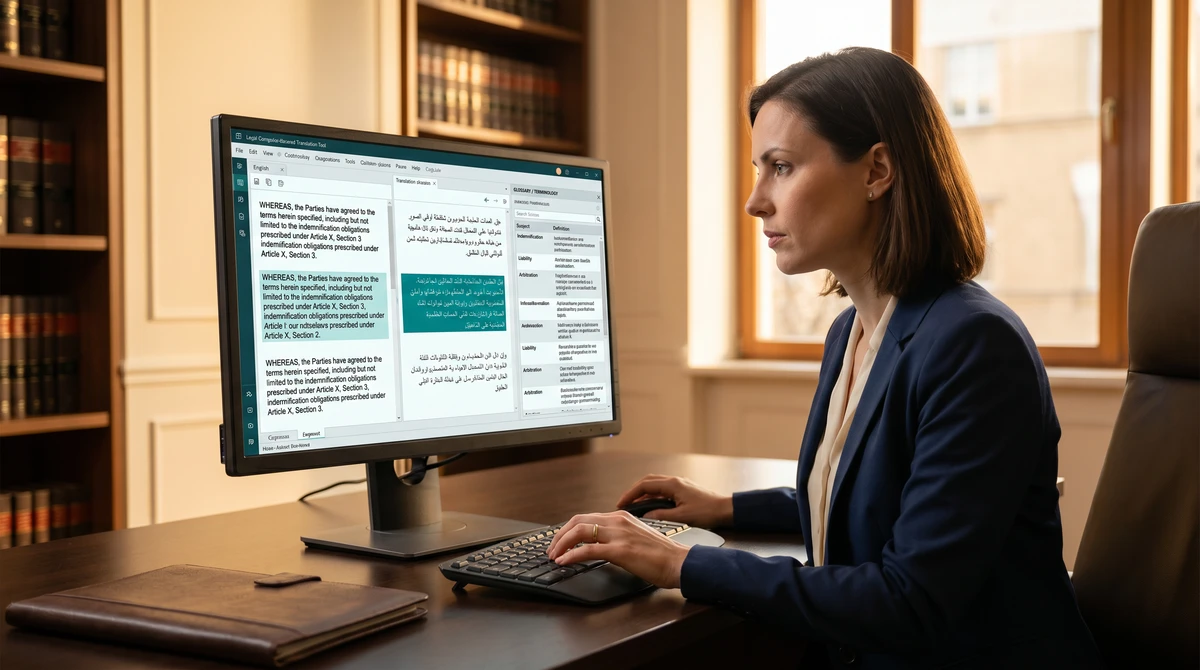
A legal translator reviewing a contract in a two-pane translation tool in a warm law office
250+ Languages
40,000+ Vetted linguists
ISO 17100 Translation review controls
1 Named PM per matter
Evidence for review

This is not a public case study claim. It is DD-owned evidence a buyer can request when the work needs vendor review before a scope is approved.

Ask for proof details
Buyer type
Legal buyer, compliance owner, program lead, or vendor manager qualifying a regulated language supplier.
Problem
The buyer needs legal language work scoped with the setting, audience, access controls, and review process confirmed before commitment.
Scope
Legal work across files, sessions, media, or data tasks where privacy, recipient requirements, and audit expectations matter.
Constraint
Regulated buyers need proof without public client disclosure; DD cannot publish client-specific outcomes unless the client clears them.
DD action
DD confirms the legal use case, content handling, role-scoped access, review chain, and missing inputs before production.
Evidence available
Private proof can include a redacted request checklist, access-control checklist, QA summary format, and delivery record format for the relevant setting.
Outcome
The buyer can verify whether DD can handle the setting before sharing sensitive content or scheduling the engagement.
Disclosure status
DD-owned proof only. Public client outcomes require approval; redacted process artifacts can be shared when disclosure terms allow.

How DD checks it

What enterprise buyers need from legal — and how DD delivers it.

DD confirms the matter type, the receiving party, the format requirement, the certification need, and the confidentiality scope before production starts. That prevents the most common legal language failure: a file or session that is linguistically correct but misaligned with what the court, agency, counsel, or client actually requires.

Certified translation for legal use requires more than a linguist's stamp. Immigration filings, court submissions, corporate agreements, real estate closings, and evidence records each carry distinct format requirements, declaration wording standards, and agency expectations. DD reviews recipient rules, declaration text, name spelling confirmation, bilingual layout requirements, and any agency or evaluator notes at request review, before accepting the project. Format preservation (tables, headers, signatures, stamps, layout) is confirmed at scope, not checked at delivery.

Legal interpretation covers a specific range of settings where the record matters. Depositions, client consultations, hearings, examination under oath, arbitration sessions, and immigration interviews each require an interpreter who understands the proceeding format, the confidentiality scope, and the record implications of their role. DD confirms language pair, modality, setting, subject matter, and any qualification or state-registry consideration before the booking is confirmed. Interpreter availability for uncommon language pairs is checked before a date is committed.

eDiscovery and large-volume document review projects require a different structure than standard translation engagements. The document population, review platform, annotation schema, privilege review rules, and output format must all be confirmed before production. DD applies role-scoped access controls where each reviewer accesses only the content assigned to them, and NDA controls apply before any content is distributed. For projects requiring human-only review with no AI-assisted document processing, DD delivers that.

Multilingual client communication and matter support for law firms and corporate legal teams operates under under-your-brand terms where required. All PM, linguist, and file delivery activity operates under the firm's presentation requirements. Review documentation and delivery records are available for audit. Sub-vendor relationships with law firms and language service providers are structured from the first project with zero end-client disclosure unless the firm authorizes it.

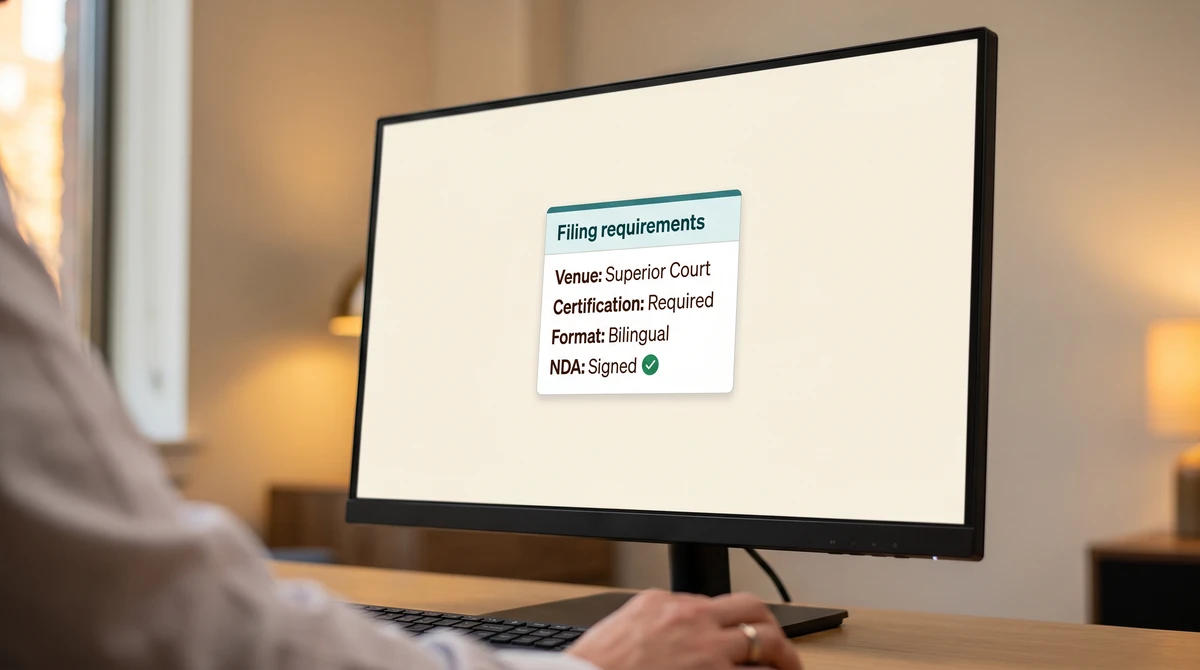
In the tool

Receiving venue, certification, format, and confidentiality confirmed before production — not reconciled at filing.

A close-up of a legal filing-requirements card showing receiving venue, certification required, bilingual format, and NDA signed

Step by step

  1. Name the matter type and receiving party

    Share the matter type, receiving party (court, agency, counsel, client), file or session type, any certification or declaration requirement, confidentiality scope, and deadline.

  2. Receiving venue and format confirmed

    For certified translations: recipient rules, declaration wording, name spelling, bilingual layout, and file format are reviewed before production starts. For interpretation: language pair, modality, setting, and any qualification consideration are confirmed before the booking is placed.

  3. Production under matter confidentiality

    All linguists sign NDAs before receiving content. Access is role-scoped and revoked on project close. For sensitive matter files, browser-only workflows are available. Sub-vendor relationships with law firms operate with zero end-client disclosure.

  4. Delivery with audit trail available

    QA documentation and delivery records are available on request for any project, relevant for legal audit trails, law firm sub-vendor reviews, and compliance submissions.

Quality and delivery

What buying teams need. What DD structures every engagement around.

Receiving venue confirmed before production

DD confirms the receiving party — court, agency, counsel, or client — and the format requirement before accepting any legal project. Certification wording, bilingual layout, and filing format are reviewed at the start. A file that is linguistically correct but misaligned with the receiving venue is not a deliverable.

Independent review aligned with ISO 17100

The production linguist and the reviewer are always separate people. Error categorization follows a written review standard aligned with ISO 17100 requirements: critical, major, minor. QA documentation and delivery records are available for any project — relevant for legal audit trails and law firm sub-vendor reviews.

NDA controls and matter confidentiality

All linguists sign NDAs before receiving any project content. Each person accesses only the content assigned to them; access is revoked on project close. For sensitive matter files, browser-only, no-download workflows are available. Sub-vendor relationships with law firms operate with zero end-client disclosure unless the firm authorizes it.
One named PM per matter

The PM owns the engagement from first contact through delivery — scope confirmation, linguist matching, QA review, and file handoff. For ongoing matters and multi-document programs, the PM maintains continuity across files. One contact for status, escalation, and scope changes.

Quality-management controls Information-security controls Translation-review controls Independent certification held for all three control areas

Quality stages

  • Receiving venue review

    The court, agency, or evaluator requirements are reviewed before accepting the project: declaration wording, format, certification standards, and any filing-specific layout rules.

  • Independent translation and review

    The production linguist and the reviewer are always separate people. Error categorization follows a written standard aligned with ISO 17100 requirements: critical, major, minor.

  • NDA and access controls

    All linguists operate under NDA for the matter. Each person accesses only the content assigned to them; access is revoked on project close. Browser-only workflows available for sensitive files.

  • QA documentation delivered

    Written QA logs, error records, and delivery documentation are available on request, structured for legal audit trails and sub-vendor compliance reviews.

Where this helps

Use this service when the stakes are clear.

  • Certified translation for immigration filings, court submissions, and government agency requirements
  • Deposition, hearing, and examination-under-oath interpretation with qualification checks
  • Large-volume document review and eDiscovery language support
  • Corporate agreement, contract, and regulatory translation with independent review
  • Multilingual client communication and matter support under firm branding
  • Immigration interpretation and document services for practitioners and agencies
What to send first

Four details start the scope.

  1. Matter type and receiving party — court, agency, counsel, client, or internal
  2. File or session format and any certification or declaration requirement
  3. Confidentiality scope and access restriction
  4. Deadline, volume, and any platform or format constraint
Send a legal request

Name the matter type, receiving party, language pair, file or session type, any certification or format requirement, and the deadline. DD returns scope confirmation and PM assignment before work begins.


Questions

Common questions before sending project details.

What does DD confirm before accepting a certified translation?

DD reviews the recipient rules (court, agency, evaluator, or counsel), the required declaration wording, name spelling confirmation, bilingual layout requirements, file format, and any agency-specific notes. These details are confirmed at request review, before production starts, to prevent format or wording rejection at submission.

How does DD handle confidentiality for legal matters?

All linguists sign NDAs before receiving any project content. Each person accesses only the content assigned to them; access is revoked on project close. For sensitive matter files, browser-only workflows are available: no download, no local copy, no screenshot. Sub-vendor relationships with law firms operate with zero end-client disclosure unless the firm authorizes it.

Can DD supply interpreters for depositions and hearings?

Yes. DD confirms language pair, modality, setting, subject matter, and any state-registry or qualification consideration before the booking is committed. For uncommon language pairs, availability is checked before a date is promised, not after a booking is placed. Post-session documentation is available on request.

What is DD's approach to eDiscovery document review?

Large-volume document review projects require separate scoping: document population, review platform, annotation schema, privilege review rules, and output format are confirmed before production opens. Role-scoped access and NDA controls apply before any content is distributed. Human-only review workflows are available where AI-assisted processing is excluded.

Does DD cover immigration-specific language services?

Yes. Immigration work spans certified document translation (birth certificates, marriage records, court orders, government IDs), interpretation for asylum interviews and immigration hearings, and multilingual client communication for practitioners. Language pair availability for immigration-common languages is confirmed when your request arrives.

What quality controls apply to legal translation?

The production linguist and the reviewer are always separate people. Error categorization follows a written review standard aligned with ISO 17100 requirements: critical, major, minor. QA documentation is available on request. For legal matters requiring an audit trail, delivery records are retained and released on request.


Related

Keep moving from the same request.

Dynamic Dialects 200 E Robinson Street, Suite 1120-H16 Orlando, FL 32801 (407) 537-2522 info@dynamicdialects.com Mon-Fri | 8a-7p ET
Send the requirement

Get the right scope in writing.

Share the language pair, file type, audience, or problem. DD replies with availability, open questions, handling notes, and the next step before work starts.

Four fields are enough to start. Add files later if handling needs review.