
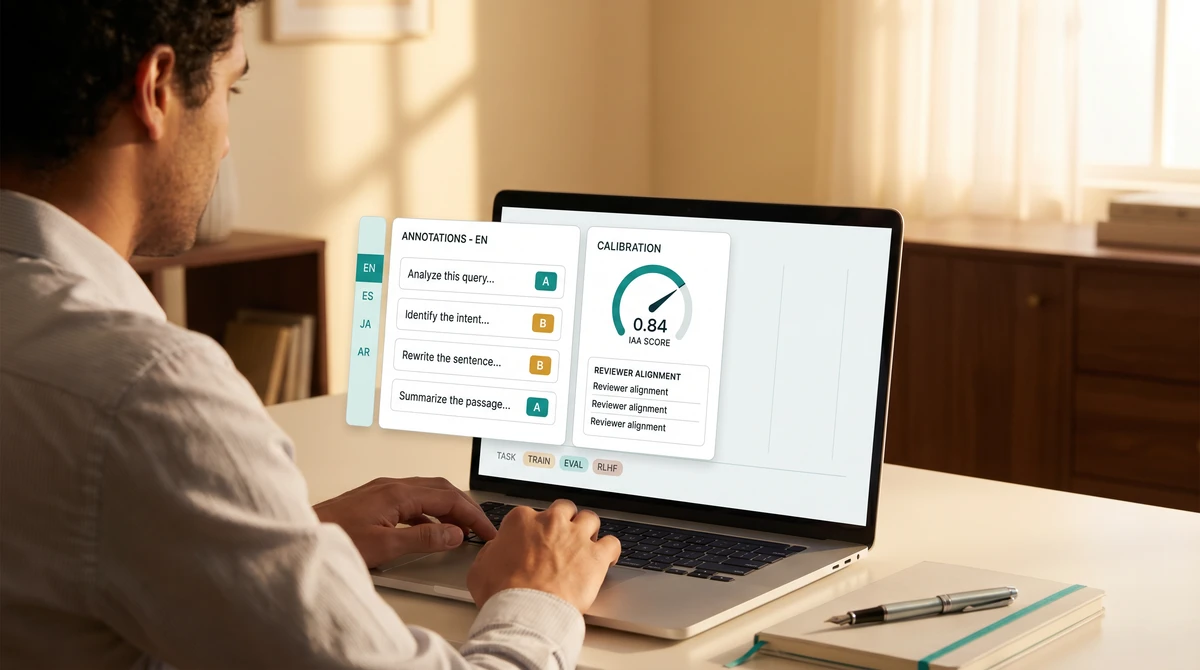
Annotator pool qualified per task type, includes rare and accented pairs
AI data services
Scope AI data services with task type, language coverage, and reviewer rubric settled first.
ML engineers get JSONL/Parquet data sets with schema-confirmed fields that drop directly into training pipelines. AI product managers receive rubric-calibrated data with annotator alignment scores and edge-case logs for model card documentation. Data operations leads get scalable multilingual coverage across 250+ languages with reviewer-grade QA per sample band and delta-update support for iterative program rounds.
Upload files for a quote
Short form: name, work email, data type, locale notes, and sample files or links if ready.
Training data, eval sets, red-team, RLHF, instruction-tuning
Agreement target recorded per program against a rubric training sample
JSONL, Parquet, CSV with schema delivered alongside the data
Dynamic Dialects supports requests across 250+ languages with ISO 9001/27001 operating controls, ISO 17100 applied to translation scopes, 40,000+ vetted linguists, named project coordination, and written confirmation before production work begins.
Evidence for review
What DD can show before a buyer commits.
This is not a public case study claim. It is DD-owned evidence a buyer can request when the work needs vendor review before a scope is approved.
Ask for proof details- Buyer type
- AI data services ML engineer, data operations lead, or AI product manager checking label taxonomy, acceptance criteria, output schema, and reviewer alignment before dataset production.
- Problem
- The buyer needs scope ai data services with task type, language coverage, and reviewer rubric settled first. scoped by dataset modality, label categories with examples, acceptance criteria, output format, and reviewer qualifications before production begins.
- Scope
- AI data services work coordinated by DD with written request review, named PM ownership, and review records matched to the request type.
- Constraint
- This page cannot rely on a public case study yet; it must point to DD-owned proof artifacts and disclosure-safe process evidence.
- DD action
- DD confirms the inputs, missing details, staffing option, quality check, and delivery record before production work begins.
- Evidence available
- Private proof can include a request-specific checklist, redacted QA summary format, delivery record format, and sourcing or reviewer notes.
- Outcome
- The buyer can judge whether DD fits the requirement before sending production files or adding this service to a vendor shortlist.
- Disclosure status
- DD-owned proof only. Public outcomes require client approval; redacted process artifacts can be shared when terms allow.
How the work runs
-
Scope the program
Task type, target languages with regional variants, reviewer rubric, agreement target, and delivery format settled in writing first.
-
Train on the rubric
Rubric training sample scored by reviewers against the rubric. Annotators work the training sample before production and the agreement score is recorded.
-
Annotate against the rubric
Native-language annotators work in-tool with the agreed rubric and edge-case guidance. Borderline cases flagged for reviewer adjudication.
-
Run reviewer-grade QA
Reviewer-grade QA on every sample band before release. Annotators who fall below the agreement floor are retrained or replaced.
-
Deliver and archive
Data set delivered in JSONL, Parquet, or CSV with schema. Calibration report, edge-case log, and license records archived for compliance review.
What DD checks before quoting
- Source file review Completeness, legibility, format, and any visible damage or quality issues.
- Pair confirmation Source → target language, variant, dialect, and script requirements.
- Purpose check Receiving office, certification or notarization need, and deadline driver.
- QA plan Review type, sample size, sign-off owner, and any client-specific checklist.
- Delivery format File type, naming convention, storage method, and handoff protocol.
- Risk note Known constraints, specialist availability, and contingency if timing shifts.
Example scope — actual checks vary by project type and client requirements.
Each AI data program starts with a written specification confirming task type (multilingual training data generation, evaluation set creation, red-team prompt sourcing, RLHF preference data, instruction-tuning data, supervised fine-tuning examples), target languages and locales (with regional variant per language), reviewer rubric and edge-case guidance, a rubric training sample with reviewer alignment scored before production starts, annotator pool qualification per language, reviewer agreement score target, and delivery format (JSONL, Parquet, CSV with schema). Annotators work against the agreed rubric with reviewer-level QA on every sample band before the data set is released. Engineering teams get schema-validated files; product teams get alignment reports for stakeholder review; compliance teams get license and consent records archived per record.
For annotation work, DD checks label definitions, examples, sample review needs, and output format before quoting.
What this page helps you send
- Multilingual training data sourcing and writing for LLM pretraining and fine-tuning across 250+ languages.
- Evaluation set creation with verified reference answers, edge-case prompts, and reviewer-graded scoring.
- Red-team prompt sourcing across safety, jailbreak, prompt-injection, and harmful-output categories per language and locale.
- RLHF and DPO preference data with paired completions, ranking rationale, and annotator alignment.
- Instruction-tuning examples and supervised fine-tuning (SFT) data with reviewer-graded sample quality.
What you receive
- Annotated data set in the agreed format and schema with reviewer-grade QA per sample band.
- Rubric training report with agreement scores and annotator alignment notes.
- Edge-case sample log with rubric notes and reviewer rationale on borderline cases.
- License and consent records archived for compliance review on request.
- Delta updates against the same rubric and annotator pool for subsequent program rounds.
Questions teams ask first
What task types are supported?
Multilingual training data generation, evaluation set creation, red-team prompt sourcing (safety, jailbreak, prompt-injection, harmful-output), RLHF and DPO preference data, instruction-tuning examples, and supervised fine-tuning data are supported. The task type is confirmed during scoping so annotators with the matching qualification and reviewer rubric are assigned.
How is rubric training handled?
Each program starts with a rubric training sample scored by reviewers, with edge-case notes added. Annotators work the training sample before production starts and the reviewer agreement score is recorded. Annotators who score below the agreed agreement floor are retrained or replaced before production data is released.
How are red-team prompts sourced per language?
Red-team prompt categories (jailbreak attempts, harmful-output elicitation, prompt-injection patterns, multilingual safety bypass attempts) are sourced by native annotators per language and locale. Locale-specific cultural attack vectors are scoped per market rather than translated from an English source set.
What delivery formats are supported?
Standard delivery formats include JSONL with field-level schema, Parquet for large data sets, and CSV with explicit schema. Schema fields are confirmed in scoping (sample ID, locale, task type, reference answer, annotator ID, agreement band, training tier) so the data set drops directly into the model training pipeline.
How is consent and license handled?
Source content consent and license terms are confirmed in scoping per content origin (annotator-written, user-generated with consent, public-domain, proprietary licensed). Records are timestamped and archived for compliance review. Annotator-written content is licensed per the annotator contract; user-generated content requires consent timestamped per record.