
Speaker pools recruited per program, includes rare and accented pairs
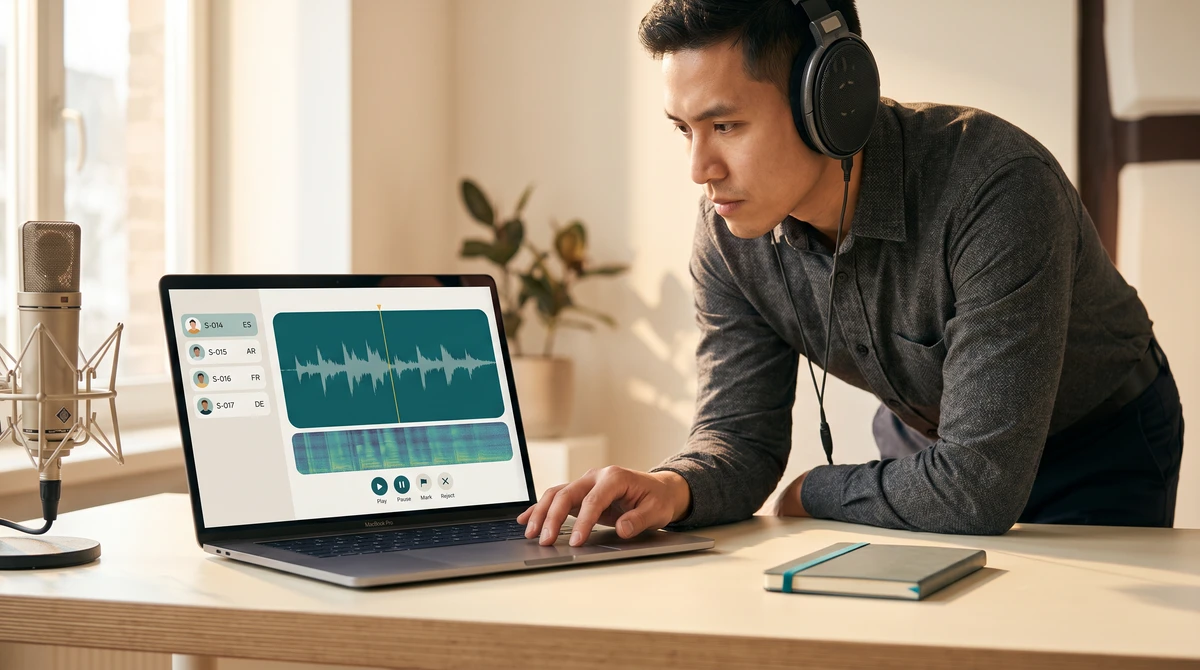
Speech data collection services
Scope multilingual speech data collection with language, accent, and audio specification settled first.
Collect audio corpora in the requested language and accent profile with prompt design, speaker recruitment specification, audio specification, consent and licensing, and metadata schema confirmed in writing before any recording begins.
Upload files for a quote
Short form: name, work email, data type, locale notes, and sample files or links if ready.
Scripted utterance, voice prompt, conversational dialog, in-the-wild
Commercial training use confirmed in writing per speaker
Audio QA and metadata QA on every file before release
Dynamic Dialects supports requests across 250+ languages with ISO 9001/27001 operating controls, ISO 17100 applied to translation scopes, 40,000+ vetted linguists, named project coordination, and written confirmation before production work begins.
Evidence for review
What DD can show before a buyer commits.
This is not a public case study claim. It is DD-owned evidence a buyer can request when the work needs vendor review before a scope is approved.
Ask for proof details- Buyer type
- Speech data collection services ML engineer, data operations lead, or AI product manager checking label taxonomy, acceptance criteria, output schema, and reviewer alignment before dataset production.
- Problem
- The buyer needs scope multilingual speech data collection with language, accent, and audio specification settled first. scoped by dataset modality, label categories with examples, acceptance criteria, output format, and reviewer qualifications before production begins.
- Scope
- Speech data collection services work coordinated by DD with written request review, named PM ownership, and review records matched to the request type.
- Constraint
- This page cannot rely on a public case study yet; it must point to DD-owned proof artifacts and disclosure-safe process evidence.
- DD action
- DD confirms the inputs, missing details, staffing option, quality check, and delivery record before production work begins.
- Evidence available
- Private proof can include a request-specific checklist, redacted QA summary format, delivery record format, and sourcing or reviewer notes.
- Outcome
- The buyer can judge whether DD fits the requirement before sending production files or adding this service to a vendor shortlist.
- Disclosure status
- DD-owned proof only. Public outcomes require client approval; redacted process artifacts can be shared when terms allow.
How the work runs
-
Scope the program
Language, accent, demographic balance, recording type, audio specification, consent and license terms, and metadata schema confirmed in writing first.
-
Recruit speakers
Speaker pool sized per demographic cell. Rare and accented pairs windowed by available speaker depth and recorded against the program scope.
-
Record against specification
Studio condenser, calibrated headset, or smartphone capture matched to the agreed audio specification, sample rate, channel layout, and ambient noise expectation.
-
Run audio QA on every clip
Signal level, ambient noise floor, prompt match, speaker ID attribution, and clip integrity verified before any file is released to the model team.
-
Release the corpus
Audio files plus speaker metadata sheet, transcription pairs when in scope, consent and license records archived for compliance review on request.
What DD checks before quoting
- Source file review Completeness, legibility, format, and any visible damage or quality issues.
- Pair confirmation Source → target language, variant, dialect, and script requirements.
- Purpose check Receiving office, certification or notarization need, and deadline driver.
- QA plan Review type, sample size, sign-off owner, and any client-specific checklist.
- Delivery format File type, naming convention, storage method, and handoff protocol.
- Risk note Known constraints, specialist availability, and contingency if timing shifts.
Example scope — actual checks vary by project type and client requirements.
Each speech data collection program starts with a written specification confirming language and accent coverage (general L1, regional accent, code-switching pairs), recording type (scripted utterances, prompted voice phrases, conversational dialog, wake-word capture, read-speech, in-the-wild spontaneous), audio specification (sample rate, bit depth, channel layout, ambient noise floor, microphone class), speaker demographic balance (age band, gender, regional, L1 vs L2), consent and license terms (commercial training use, redistribution scope, opt-out process), and the metadata schema delivered alongside the audio (speaker ID, locale, prompt text, transcription pair, audio file checksum). Recording runs against the agreed specification with reviewer-level audio QA on every clip before the audio package is released.
For annotation work, DD checks label definitions, examples, sample review needs, and output format before quoting.
What this page helps you send
- Multilingual TTS corpus collection (scripted utterances, phonetically balanced sentences) for voice assistant and audiobook narration training.
- ASR and STT training corpora across general accents, regional accents, and code-switching pairs.
- Wake-word and trigger-phrase capture with controlled ambient noise variations.
- Conversational dialog capture between two or more speakers for dialog AI and meeting transcription model training.
- Read-speech corpora with verified transcription pairs for speech model evaluation.
- Accent and dialect coverage for rare and refugee-resettlement languages where most marketplaces lack speaker depth.
- In-the-wild spontaneous speech capture with consent and metadata recorded per session.
- Re-recording or augmentation of an existing audio set with matching speaker profile and audio specification.
What you receive
- Audio files in the agreed format and specification with reviewer-level audio QA on every clip.
- Speaker metadata sheet (ID, locale, demographic fields, consent timestamp, license terms).
- Transcription pairs delivered alongside the audio when the program scope requires them.
- Consent and license records archived for compliance review on request.
- Re-recording or replacement of any clip that fails QA at no additional speaker cost.
Questions teams ask first
What recording types are supported?
Scripted utterances (phonetically balanced sentences read from a prompt), prompted voice-phrase capture (wake-words, short voice-control phrases), conversational dialog between two or more speakers, read-speech for transcription pair training, and in-the-wild spontaneous capture with consent. The recording type is confirmed during the program scoping so the audio specification and the speaker recruitment match what the model team actually needs to train against.
How is speaker recruitment handled for rare languages and accents?
Speaker recruitment for rare and refugee-resettlement languages and for under-represented accent pairs (regional accents within a language, L2 speakers learning the language, code-switching speakers fluent across two locales) is scoped per program with a target speaker count per demographic cell. For ultra-rare pairs, the available speaker pool size and the target completion window are recorded in writing rather than promised generically.
What audio specifications are supported?
Common recording specifications include 16 kHz, 22.05 kHz, 44.1 kHz, or 48 kHz sample rates at 16-bit or 24-bit depth, mono or stereo channel layouts, microphone class (broadcast condenser for studio recording, calibrated headset for prompted voice-phrase capture, smartphone microphone for in-the-wild capture), and a target ambient noise floor. The audio specification is confirmed in the scoping so the recorded clips match what the model training pipeline expects.
How is consent and license handled for commercial training use?
Each speaker signs a consent and license form confirming commercial training use, redistribution scope (internal training only, or licensed redistribution to a partner), and opt-out process. The consent record is timestamped and archived for compliance review. Speakers who request opt-out have their audio removed from the corpus and a replacement clip is recorded at no additional cost when the program scope requires demographic balance.
What metadata is delivered alongside the audio files?
Standard speech corpus metadata includes a speaker ID (pseudonymized), locale code, demographic fields (age band, gender, regional accent), prompt text, transcription pair when the program scope requires it, audio file checksum for integrity verification, and the consent timestamp. The metadata schema can be adjusted in the scoping to match the model team's data pipeline expectations.
Is transcription delivered alongside the audio?
Yes when the program scope requires it. Transcription pairs (audio file plus verbatim transcript in the source language) are produced with reviewer-level QA against the audio. For STT and ASR training the transcript is verified character-by-character against the recording. For TTS training the transcript matches the prompt source. Transcription is scoped separately when the audio corpus is the only requirement.
How is audio QA done on every clip?
Audio QA covers signal level (no clipping, no excessive low signal), ambient noise floor (within the agreed range), speaker identification (clip attributed to the correct speaker ID), prompt match (the audio matches the source prompt when the recording type is scripted), and clip integrity (no truncation, no pops, no gain artifacts). Clips that fail QA are re-recorded at no additional speaker cost rather than shipped as-is.
Can existing audio sets be augmented or re-recorded?
Yes. Existing audio sets can be augmented with additional speakers, accents, or recording types to match a wider data balance requirement, or re-recorded against a tighter audio specification when the model training pipeline changes (sample rate change, channel layout change, ambient noise tightening). Augmentation programs match the source set's speaker profile so the combined corpus remains statistically clean.