
FCC for broadcast, ADA, CVAA, AODA accessibility frameworks
Audio description services
Scope audio description with platform, accessibility standard, and narration style settled first.
Deliver audio description narration that meets FCC, ADA, and CVAA accessibility expectations with content type, script style, voice talent, mix specification, and platform delivery format confirmed in writing before scripting starts.
Upload files for a quote
Short form: name, work email, runtime, platform, target languages, and media files or links if ready.
Standard, extended, and integrated narration approaches
Separate description track or pre-mixed broadcast file
Audio description in English and target languages with native voice talent
Dynamic Dialects supports requests across 250+ languages with ISO 9001/27001 operating controls, ISO 17100 applied to translation scopes, 40,000+ vetted linguists, named project coordination, and written confirmation before production work begins.
Evidence for review
What DD can show before a buyer commits.
This is not a public case study claim. It is DD-owned evidence a buyer can request when the work needs vendor review before a scope is approved.
Ask for proof details- Buyer type
- Audio description services media producer, localization manager, or accessibility lead checking runtime, platform format, speaker rules, and output spec before production.
- Problem
- The buyer needs audio description services scoped by runtime, platform, target languages, speaker treatment, timing constraints, and output files before quote approval.
- Scope
- Audio description services work coordinated by DD with written request review, named PM ownership, and review records matched to the request type.
- Constraint
- This page cannot rely on a public case study yet; it must point to DD-owned proof artifacts and disclosure-safe process evidence.
- DD action
- DD confirms the inputs, missing details, staffing option, quality check, and delivery record before production work begins.
- Evidence available
- Private proof can include a request-specific checklist, redacted QA summary format, delivery record format, and sourcing or reviewer notes.
- Outcome
- The buyer can judge whether DD fits the requirement before sending production files or adding this service to a vendor shortlist.
- Disclosure status
- DD-owned proof only. Public outcomes require client approval; redacted process artifacts can be shared when terms allow.
How the work runs
-
Scope the program
Content type, accessibility standard, script style, narration timing, voice talent, mix specification, and delivery format settled in writing first.
-
Write the description script
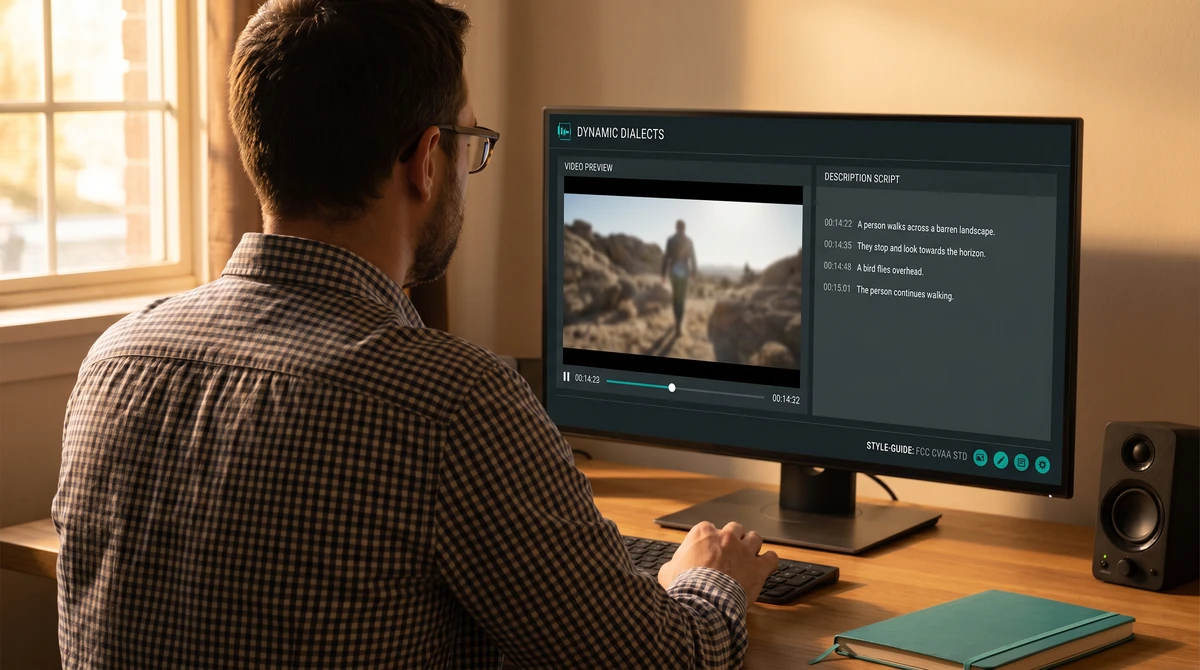
Native audio describer writes timestamped narration after viewing the content. Reviewer QA confirms timing fits the natural dialogue gaps.
-
Record the narration
Voice talent records the description against the agreed audio specification. Reviewer QA on every clip before mixing.
-
Mix or deliver separate track
Pre-mixed program file with description embedded, or separate description audio track for player-side mix per the delivery format scope.
-
Confirm and close
Style guide alignment confirmation for platform-specific delivery (Netflix, Hulu, etc.). Re-record and re-mix scope for source re-edits when in agreement.
What DD checks before quoting
- Source file review Completeness, legibility, format, and any visible damage or quality issues.
- Pair confirmation Source → target language, variant, dialect, and script requirements.
- Purpose check Receiving office, certification or notarization need, and deadline driver.
- QA plan Review type, sample size, sign-off owner, and any client-specific checklist.
- Delivery format File type, naming convention, storage method, and handoff protocol.
- Risk note Known constraints, specialist availability, and contingency if timing shifts.
Example scope — actual checks vary by project type and client requirements.
Each audio description program starts with a written specification confirming content type (film, TV episode, streaming series, marketing video, live event, museum exhibit), accessibility standard (FCC for broadcast TV, ADA Title III for public-facing video, CVAA for IP-delivered video, AODA for Ontario), script style (standard description, extended description for educational content, integrated description for narrative content), narration timing (in-gap between dialogue, fitting within the natural pauses), voice talent (single narrator or multi-voice for multi-character content), audio mix specification (description track separate from program audio for player-side mix, or pre-mixed program with description embedded), and delivery format (separate audio file in WAV or AAC, or fully mixed broadcast file). A native audio describer writes the script after viewing the content and reviewer QA against accessibility standards confirms timing and clarity before recording.
For media work, DD checks source quality, timing, platform format, speaker treatment, and output files before quoting.
What this page helps you send
- Audio description for FCC-regulated broadcast TV programming with separate description-track or pre-mixed delivery.
- Streaming audio description for Netflix, Disney+, Hulu, Amazon Prime, and other OTT platforms with per-platform style guides honored.
- Film and documentary audio description with extended narration for cultural, educational, and historical content.
- Live event audio description for theatre, sports, and broadcast live events with real-time describer support.
- Museum and exhibit audio description for accessibility-mandated visitor programs with installation-ready audio files.
What you receive
- Audio description script reviewed against the accessibility standard with timing aligned to the content gaps.
- Recorded description narration in the agreed audio specification with reviewer QA on every clip.
- Pre-mixed program file with description embedded, or separate description audio track for player-side mix.
- Style guide alignment confirmation for platform-specific audio description (Netflix, Hulu, etc.).
- Re-record and re-mix of any description for a re-edit of the source content at no additional describer cost when in scope.
Questions teams ask first
What is audio description and who is it for?
Audio description is scripted narration of visual content (action, scene change, on-screen text, facial expression) inserted into the natural gaps between dialogue. It makes film, TV, streaming, and live events accessible to blind and low-vision viewers. FCC mandates audio description for a baseline of broadcast TV programming, ADA Title III applies to public-facing video, and CVAA covers IP-delivered video.
What is the difference between standard, extended, and integrated description?
Standard description fits narration into the natural gaps between dialogue. Extended description pauses the program to insert longer narration for educational or culturally dense content. Integrated description weaves description into the narrative voice or narration track during production (uncommon in post-production audio description). The style is confirmed in scoping based on content type and accessibility standard.
Which platforms have specific audio description style guides?
Netflix maintains the Audio Description Style Guide. Hulu, Disney+, Amazon Prime, Apple TV+, and BBC each publish style guides covering script style, voice talent, timing, and mix specification. Platform-specific style guides are honored when distribution to those platforms is in scope; the applicable guide is confirmed during scoping.
Can audio description be delivered in target languages?
Yes. Audio description in English is the standard for US broadcast and most US streaming. Target-language audio description (Spanish for Latin American distribution, Japanese for Japan distribution, etc.) is scoped per market with native describers writing the script and native voice talent recording the narration. The target-language audio description ships alongside the localized program audio.
How is live event audio description handled?
Live event audio description (theatre, sports, broadcast live events) is delivered by professional audio describers narrating in real time via a wireless audio feed to receivers held by audience members or via a broadcast audio description track. Live events are scoped per session with target latency and rehearsal requirements confirmed in advance.