
International Association of Conference Interpreters standards for working time and pairing
Conference interpretation services
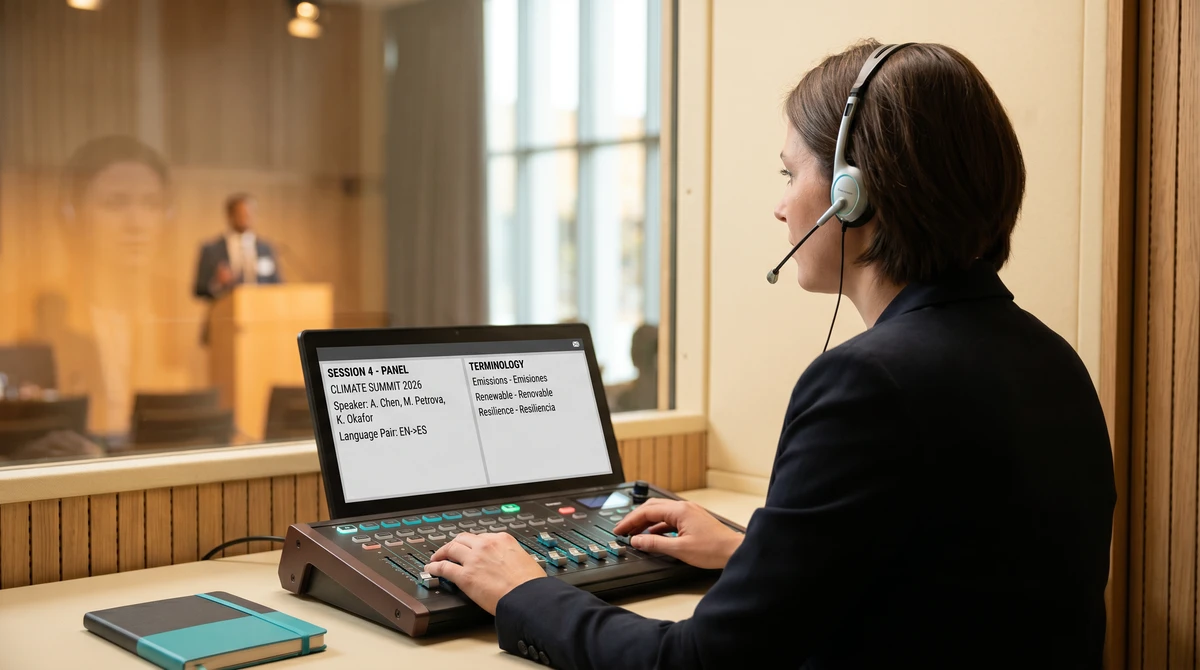
Scope conference interpretation with event type, language pairs, mode, and booth setup settled first.
Run conference interpretation (simultaneous or consecutive) for an event with the interpreter pairing, booth setup, RSI platform, terminology preparation, and recording policy confirmed in writing before the session goes live.
Check interpreter availability
Short form: name, work email, language, date, time, setting, and modality.
ISO-compliant interpretation booths with console and audio engineer support
Interprefy, KUDO, Zoom Interpretation, Webex Interpretation
Simultaneous, consecutive, chuchotage, and remote simultaneous interpretation
Dynamic Dialects supports requests across 250+ languages with ISO 9001/27001 operating controls, ISO 17100 applied to translation scopes, 40,000+ vetted linguists, named project coordination, and written confirmation before production work begins.
Evidence for review
What DD can show before a buyer commits.
This is not a public case study claim. It is DD-owned evidence a buyer can request when the work needs vendor review before a scope is approved.
Ask for proof details- Buyer type
- Conference interpretation services event coordinator, court administrator, or healthcare scheduler checking language match, setting, modality, and qualification needs before session confirmation.
- Problem
- The buyer needs conference interpretation services scoped by language, setting, modality, participant needs, qualification requirements, and schedule before session confirmation.
- Scope
- Conference interpretation services work coordinated by DD with written request review, named PM ownership, and review records matched to the request type.
- Constraint
- This page cannot rely on a public case study yet; it must point to DD-owned proof artifacts and disclosure-safe process evidence.
- DD action
- DD confirms the inputs, missing details, staffing option, quality check, and delivery record before production work begins.
- Evidence available
- Private proof can include a request-specific checklist, redacted QA summary format, delivery record format, and sourcing or reviewer notes.
- Outcome
- The buyer can judge whether DD fits the requirement before sending production files or adding this service to a vendor shortlist.
- Disclosure status
- DD-owned proof only. Public outcomes require client approval; redacted process artifacts can be shared when terms allow.
How the work runs
-
Scope the program
Event type, session count, language pairs, interpretation mode, booth or RSI setup, and recording policy settled in writing first.
-
Pair the interpreters
Two interpreters per booth per language for sessions over 60 minutes. AIIC-aligned working time. Relay-language pairing for rare-pair coverage.
-
Prepare terminology
Subject-matter glossary, speaker name list, slide preview, and prepared content reviewed by the interpreter team in advance under the AIIC confidentiality requirement.
-
Run pre-event tech check
ISO 22259-compliant booth setup tested with audio engineer support, or RSI platform configuration tested against the venue connection.
-
Interpret and close
Simultaneous, consecutive, chuchotage, or RSI interpretation delivered. Post-event recording archive of the interpretation feed when in scope.
What DD checks before quoting
- Source file review Completeness, legibility, format, and any visible damage or quality issues.
- Pair confirmation Source → target language, variant, dialect, and script requirements.
- Purpose check Receiving office, certification or notarization need, and deadline driver.
- QA plan Review type, sample size, sign-off owner, and any client-specific checklist.
- Delivery format File type, naming convention, storage method, and handoff protocol.
- Risk note Known constraints, specialist availability, and contingency if timing shifts.
Example scope — actual checks vary by project type and client requirements.
Each conference interpretation engagement starts with a written specification confirming event type (multi-day conference, single-day summit, board meeting, hybrid event with on-site and remote audience), interpretation mode (simultaneous from an ISO 22259-compliant booth, consecutive at the podium, chuchotage whispered to a small group, or remote simultaneous interpretation via Interprefy, KUDO, Zoom Interpretation, Webex Interpretation), language pairs and target audience locale, interpreter pairing (two interpreters per booth per language for sessions over 60 minutes, AIIC-aligned standards for working time), booth and audio setup (on-site ISO-compliant booth with console, or RSI platform configuration), and terminology preparation (subject-matter glossary, speaker name list, slide preview reviewed in advance). A pre-event tech check is run against the venue audio system or RSI platform before the session goes live.
For interpreting work, DD checks setting, participants, qualification needs, access, and schedule before confirming the session.
What this page helps you send
- Multi-day conference simultaneous interpretation with two-interpreter booth pairing per language and audio engineer support.
- Board meeting and executive session consecutive interpretation at the podium for high-stakes content.
- Remote simultaneous interpretation (RSI) for hybrid events via Interprefy, KUDO, Zoom Interpretation, or Webex Interpretation.
- United Nations and EU-style multi-language conference interpretation with relay-language pairing for rare-pair coverage.
- Diplomatic, trade negotiation, and international tribunal interpretation with AIIC-aligned interpreter qualification.
What you receive
- Interpreter pairing matched to AIIC-aligned working time (two interpreters per booth per language for sessions over 60 minutes).
- ISO 22259-compliant booth setup (sourced and installed) or RSI platform configuration tested against the venue connection.
- Pre-event terminology preparation with subject-matter glossary, speaker name list, and slide preview reviewed in advance.
- Audio engineer support on-site for booth-based interpretation or RSI platform technical support for remote-only events.
- Post-event recording archive of the interpretation feed when the event team confirms recording in the program scope.
Questions teams ask first
What is the difference between simultaneous and consecutive interpretation?
Simultaneous interpretation runs in real time from an ISO 22259-compliant booth with the interpreter speaking the target language while the source speaker continues talking, delivered to the audience via wireless receivers. Consecutive interpretation pauses the source speaker every few sentences for the interpreter to deliver the target-language version, typically at the podium for shorter sessions and high-stakes content. The mode is confirmed per session in the program scope.
Why are two interpreters needed per booth per language?
Simultaneous interpretation at conference pace is mentally intensive. AIIC standards specify two interpreters per booth per language for sessions over 60 minutes, rotating every 20 to 30 minutes so the active interpreter can sustain accuracy across a multi-hour event without the audience seeing a quality drop. Single-interpreter coverage is scoped only for short sessions under 60 minutes.
Which RSI (remote simultaneous interpretation) platforms are supported?
Interprefy, KUDO, Zoom Interpretation, Webex Interpretation, and Microsoft Teams Premium Interpretation are supported. Custom RSI platform integrations are scoped per program with a pre-event tech check against the target platform. RSI fits hybrid events with remote audience members and reduces booth and travel cost compared to fully on-site setup.
How is terminology preparation handled for technical conferences?
A subject-matter glossary, speaker name list, slide preview, and any prepared content (papers, panel session abstracts, executive talking points) are reviewed by the interpreter team in advance. Pre-event preparation is the largest single factor in measured interpretation accuracy on technical content. The glossary is treated as confidential per the AIIC Code of Ethics confidentiality requirement.
What is relay interpretation and when is it used?
Relay interpretation passes a rare language pair through a pivot language when no direct-pair interpreter is available. Example: a Khmer speaker in a UN-style multi-language conference may be interpreted Khmer-to-English by one booth, then English-to-French, English-to-Spanish, and English-to-Arabic by the other booths simultaneously. Relay interpretation is scoped when the language matrix includes rare pairs that lack direct-pair interpreter coverage.