
Translator pool sized per market across Western, LATAM, EMEA, APAC
SaaS localization services
Scope SaaS localization with release cadence, file format, and CAT tool integration settled first.
Localize a SaaS product (UI strings, error messages, in-app help, marketing site, release notes) for target markets with Git-integrated continuous workflow, in-context UI review, and release-cycle delta translation confirmed in writing before the first sprint runs.
Upload files for a quote
Short form: name, work email, target markets, launch date, and files or screenshots if ready.
Phrase, Smartling, Crowdin, Lokalise, Transifex, SDL Trados
GitHub Actions, GitLab CI, Bitbucket Pipelines sync to the CAT tool
Weekly, biweekly, or monthly delta translation against the active TM
Dynamic Dialects supports requests across 250+ languages with ISO 9001/27001 operating controls, ISO 17100 applied to translation scopes, 40,000+ vetted linguists, named project coordination, and written confirmation before production work begins.
Evidence for review
What DD can show before a buyer commits.
This is not a public case study claim. It is DD-owned evidence a buyer can request when the work needs vendor review before a scope is approved.
Ask for proof details- Buyer type
- SaaS localization services product manager, internationalization lead, or content strategist checking market fit, string context, term lists, and import method before release.
- Problem
- The buyer needs SaaS localization services scoped by target markets, source files, term lists, character limits, QA approach, and import method before release.
- Scope
- SaaS localization services work coordinated by DD with written request review, named PM ownership, and review records matched to the request type.
- Constraint
- This page cannot rely on a public case study yet; it must point to DD-owned proof artifacts and disclosure-safe process evidence.
- DD action
- DD confirms the inputs, missing details, staffing option, quality check, and delivery record before production work begins.
- Evidence available
- Private proof can include a request-specific checklist, redacted QA summary format, delivery record format, and sourcing or reviewer notes.
- Outcome
- The buyer can judge whether DD fits the requirement before sending production files or adding this service to a vendor shortlist.
- Disclosure status
- DD-owned proof only. Public outcomes require client approval; redacted process artifacts can be shared when terms allow.
How the work runs
-
Scope the program
Release cadence, resource file format, CI integration, CAT tool, TM and termbase, and in-context review approach settled in writing first.
-
Wire up the Git sync
GitHub Actions, GitLab CI, Bitbucket Pipelines, or native CAT-tool Git sync configured. Source strings flow from the repo to the CAT tool with TM and termbase active.
-
Translate the sprint delta
Only changed strings translated per the match report. Length budgets, placeholders, and plural/gender rules respected per locale.
-
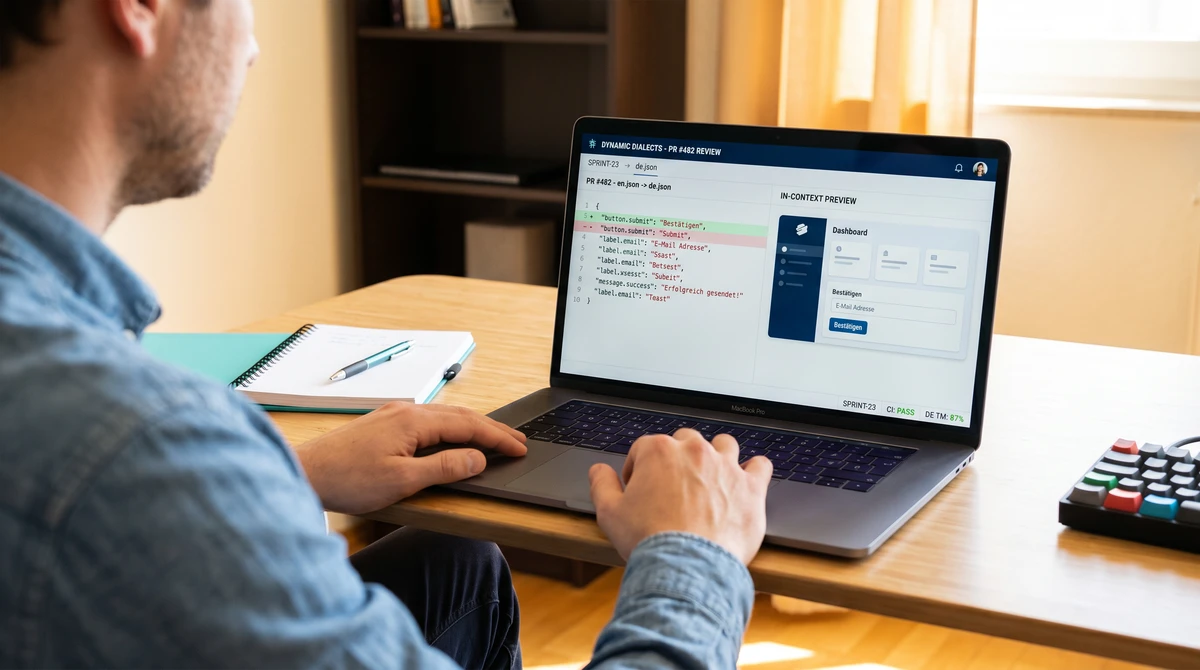
Run in-context UI review
Native reviewer reviews translated strings against screenshots, staging URL, or running-build access. Length-overflow and wrong-context issues caught before the PR merges.
-
Sync back and ship
Translated resource files sync back to the repo as a pull request. Reviewer QA runs on the changed strings before the PR merges so localization fits inside the engineering release cycle.
What DD checks before quoting
- Source file review Completeness, legibility, format, and any visible damage or quality issues.
- Pair confirmation Source → target language, variant, dialect, and script requirements.
- Purpose check Receiving office, certification or notarization need, and deadline driver.
- QA plan Review type, sample size, sign-off owner, and any client-specific checklist.
- Delivery format File type, naming convention, storage method, and handoff protocol.
- Risk note Known constraints, specialist availability, and contingency if timing shifts.
Example scope — actual checks vary by project type and client requirements.
Each SaaS localization program starts with a written specification confirming release cadence (weekly, biweekly, monthly sprint cycles), resource file format (XLIFF, JSON, YAML, PO, RESX, properties, ARB for Flutter), Git or CI integration (GitHub Actions, GitLab CI, Bitbucket Pipelines, GitHub Lokalise or Phrase Strings sync), CAT tool (Phrase, Smartling, Crowdin, Lokalise, Transifex, or SDL Trados), translation memory (TMX) and termbase (TBX) setup, in-context UI review approach (screenshots, staging URL, or running build access), and release-cycle delta translation scope. Source strings flow from the repo to the CAT tool with the TM and termbase active, and translated strings flow back to the repo on the agreed release cadence with reviewer QA on the changed strings.
For localization work, DD checks files, screenshots, term lists, character limits, feedback needs, and release format.
What this page helps you send
- SaaS UI string localization with per-element length budgets and placeholder integrity preserved per resource format.
- In-app help, tooltip, and onboarding flow localization with in-context review against the staging build.
- Marketing site, landing page, and SEO content localization aligned with the product UI terminology.
- Release notes, changelog, and email transactional content localization on the sprint cadence.
- Continuous Git-integrated localization with delta translation per pull request and reviewer QA on the changed strings.
What you receive
- Translated resource files in the source format synced back to the repo on the agreed release cadence.
- Updated TM (TMX) and termbase (TBX) maintained across releases so subsequent delta translations reuse approved content.
- In-context UI review report flagging length-overflow, missing-string, or wrong-context issues per locale.
- Locale support recommendations (plural rules, RTL layout, date and number formatting) per target market.
- Continuous sync against the Git workflow so localization stays inside the existing engineering release cycle.
Questions teams ask first
How does Git-integrated SaaS localization work?
Source strings are committed to the repo by the engineering team, picked up by the CAT tool via the CI integration (GitHub Actions, GitLab CI, Bitbucket Pipelines, or a native CAT-tool Git sync), translated against the active TM and termbase, then synced back to the repo on the agreed release cadence as a pull request. Reviewer QA runs on the changed strings before the PR merges, so localization fits inside the existing engineering release cycle rather than running as a separate handoff.
Which CAT tools and localization platforms are supported?
Phrase (formerly Memsource), Smartling, Crowdin, Lokalise, Transifex, and SDL Trados are supported end-to-end. The client's existing platform is the default when one is in use. When the client has no platform, DD recommends one based on release cadence, resource format, and team size. TM and termbase exports (TMX and TBX) are returned at project close so the localization assets stay owned by the client.
How is in-context UI review handled?
In-context UI review uses screenshots, a staging URL, or running-build access (a sandbox account with translator login). Translators see the string in context so length overflows, wrong-context translations, and placeholder issues are caught before the string ships. For visual-heavy products (design tools, dashboards), running-build access is the strongest approach.
How is delta translation handled per release sprint?
Delta translation runs against the existing TM so only the changed strings are translated against fresh effort. Reused strings draw from the TM at the agreed match band (100 percent match, in-context match, fuzzy band). Pricing reflects the match report so reused strings cost less than no-match strings. The delta is scoped per sprint with a target turnaround that fits the release window.
How are plural rules and RTL languages handled?
Plural rules per target language (English has 2 plural forms, Arabic has 6, Polish has 3, Chinese has 1) are honored in the resource file format that supports them (ICU MessageFormat, gettext, or framework-specific plural systems). RTL languages (Arabic, Hebrew, Persian) require engine and UI support for mirrored layout; the layout-mirroring requirement is confirmed in scoping rather than discovered at QA time.