
Translator pool qualified per technical subject matter (engineering, IT, hardware, regulated)
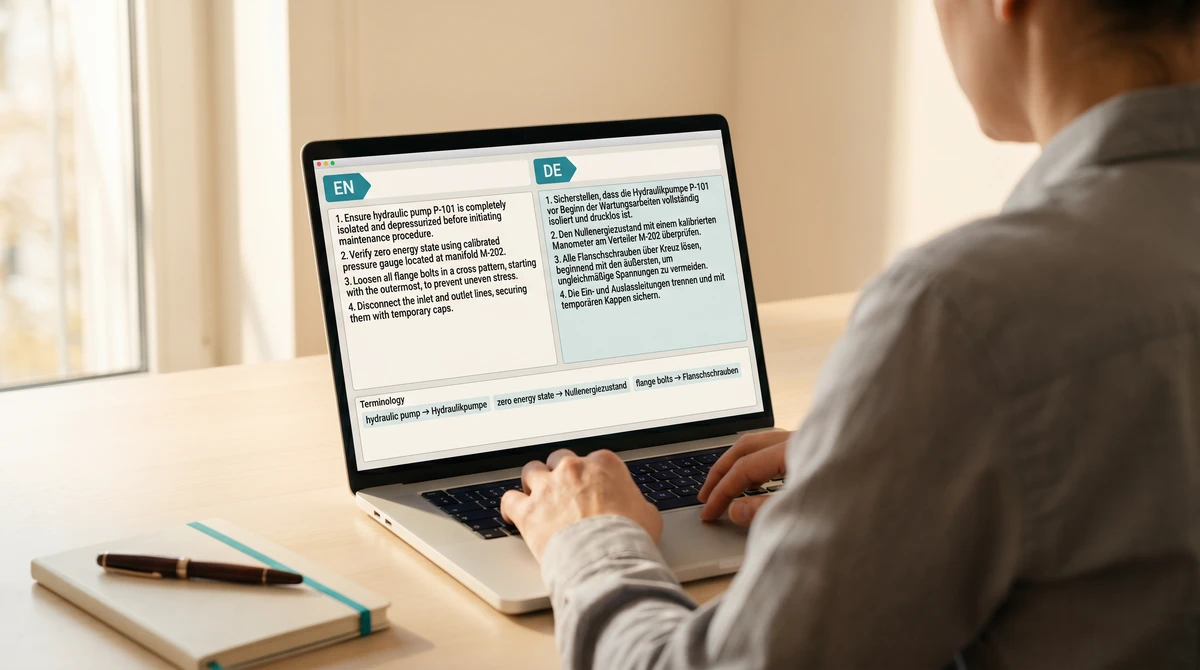
Technical translation services
Scope technical translation with terminology, file format, and style guide settled first.
Translate technical documentation (engineering manuals, software docs, datasheets, SOPs, compliance submissions) into the target languages with terminology, file format, style guide, CAT tool, and reviewer-level QA confirmed in writing before any string is touched.
Upload files for a quote
Short form: name, work email, language pair, deadline, and source files or a file link if ready.
3-step translator-reviser-reviewer flow per the standard
SDL Trados, memoQ, Phrase, Across, XTM, Smartling
Terminology governed in TBX and prior translations reused from TMX
Dynamic Dialects supports requests across 250+ languages with ISO 9001/27001 operating controls, ISO 17100 applied to translation scopes, 40,000+ vetted linguists, named project coordination, and written confirmation before production work begins.
Evidence for review
What DD can show before a buyer commits.
This is not a public case study claim. It is DD-owned evidence a buyer can request when the work needs vendor review before a scope is approved.
Ask for proof details- Buyer type
- Technical translation services document owner, legal ops lead, or compliance manager checking certification, formatting, and delivery rules before sending production files.
- Problem
- The buyer needs scope technical translation with terminology, file format, and style guide settled first. scoped by receiving forum, file condition, certification requirement, language pair, deadline, and delivery format before quote approval.
- Scope
- Technical translation services work coordinated by DD with written request review, named PM ownership, and review records matched to the request type.
- Constraint
- This page cannot rely on a public case study yet; it must point to DD-owned proof artifacts and disclosure-safe process evidence.
- DD action
- DD confirms the inputs, missing details, staffing option, quality check, and delivery record before production work begins.
- Evidence available
- Private proof can include a request-specific checklist, redacted QA summary format, delivery record format, and sourcing or reviewer notes.
- Outcome
- The buyer can judge whether DD fits the requirement before sending production files or adding this service to a vendor shortlist.
- Disclosure status
- DD-owned proof only. Public outcomes require client approval; redacted process artifacts can be shared when terms allow.
How the work runs
-
Scope the program
Content type, target languages, file format, terminology source, TM source, style guide, and QA pass scope confirmed in writing first.
-
Set up the CAT tool
SDL Trados, memoQ, Phrase, Across, XTM, or Smartling configured with the agreed termbase (TBX) and translation memory (TMX) active before any segment is opened.
-
Translate against the termbase
ISO 17100 qualified technical translators work in-tool with terminology applied automatically and prior approved translations reused per the match report.
-
Run the reviser-reviewer pass
Second-pass ISO 17100 reviser plus final reviewer QA against terminology, numeric integrity, tag integrity, and layout in the source file format.
-
Deliver and update assets
Translated files in source format with layout preserved, plus updated TMX and TBX returned for future programs and delta updates.
What DD checks before quoting
- Source file review Completeness, legibility, format, and any visible damage or quality issues.
- Pair confirmation Source → target language, variant, dialect, and script requirements.
- Purpose check Receiving office, certification or notarization need, and deadline driver.
- QA plan Review type, sample size, sign-off owner, and any client-specific checklist.
- Delivery format File type, naming convention, storage method, and handoff protocol.
- Risk note Known constraints, specialist availability, and contingency if timing shifts.
Example scope — actual checks vary by project type and client requirements.
Each technical translation program starts with a written specification confirming source content type (engineering manual, software user interface and help, API documentation, datasheet, parts catalog, SOP, regulatory submission, patent claims, safety data sheet), source file format (DITA, structured XML, FrameMaker, InDesign IDML, MadCap Flare, MS Word with styles, Markdown, structured authoring system export), CAT tool (SDL Trados Studio, memoQ, Phrase, Across, XTM, Smartling), terminology source (existing client termbase in TBX, glossary extraction from prior projects, or termbase build as part of scoping), translation memory reuse (existing TMX, prior project TM, or new TM build), style guide (client style guide, regulatory style guide, or DD baseline style guide), and reviewer-level QA (verifier-translator-reviewer 3-step or ISO 17100 reviser pass). Source files are processed in-tool with the agreed TM and termbase active, so consistent terminology and prior approved translations apply automatically across the project.
For document work, DD checks the receiving office, file condition, certificate wording, handling needs, and file format.
What this page helps you send
- Engineering manuals (user, service, installation, maintenance, parts catalogs) with figure and table layout preserved.
- Software UI strings, on-screen text, error messages, release notes, and embedded help with placeholder and variable handling.
- API documentation, developer guides, SDK reference, and technical white papers with code blocks left untranslated.
- Datasheets, hardware specifications, schematics labels, bill of materials, and assembly drawing callouts.
- Standard Operating Procedures (SOPs), factory work instructions, quality control procedures, and audit checklists.
- Regulatory submissions, declaration of conformity, CE Mark and UKCA documentation, safety data sheets (SDS) per GHS.
- Patent translations (claims, descriptions, drawings) for PCT national-phase entry and direct national filings.
- Technical training content for engineering, manufacturing, and field-service workforce localization.
What you receive
- Translated files in the source format with layout, figures, tables, and structured tags preserved.
- Updated translation memory (TMX export) and termbase (TBX export) returned with the project for future reuse.
- QA report (consistency, terminology, numeric, tag integrity, layout) on request.
- ISO 17100 attestation of the 3-step translator-reviser-reviewer flow when the program scope confirms it.
- Subsequent updates (delta translations) handled against the same TM and termbase so version-over-version consistency holds.
Questions teams ask first
Which technical subject matters are supported?
Coverage spans engineering documentation (mechanical, electrical, civil, chemical, automotive, aerospace), IT and software (API documentation, developer guides, software UI, embedded help), hardware (datasheets, schematics, BOM), manufacturing (SOPs, work instructions, quality procedures), regulated content (declaration of conformity, CE Mark, UKCA, SDS per GHS, FDA submissions), patent translations (PCT national-phase entry, direct national filings), and technical training content. The subject-matter scope is confirmed during scoping so translators with the matching qualification are assigned.
Which CAT tools are supported?
SDL Trados Studio, memoQ, Phrase (formerly Memsource), Across, XTM, and Smartling are supported end-to-end. The client's existing CAT tool and license is the default when one is in use. When the client has no CAT tool, DD runs the project in SDL Trados Studio or memoQ with the agreed TM and termbase active. Client-side TM and termbase exports (TMX and TBX) are returned at project close so the translation assets remain owned by the client.
How is terminology consistency maintained across a large technical program?
Terminology is governed in a TBX termbase active in the CAT tool during translation. The termbase is either supplied by the client, built from prior approved translations as part of the scoping, or extended throughout the project with new approved terms flagged during reviewer QA. The same termbase is reused across subsequent updates so the same source term always maps to the same target translation, version after version. Termbase updates are returned to the client at project close.
How is translation memory reuse handled?
An existing client TMX is loaded into the CAT tool at project start so prior approved translations are reused automatically. Reuse is reported per segment as 100 percent match, in-context match (ICE, 101 percent), repetition match, fuzzy match band, and no-match. Pricing typically reflects the match report rather than charging full rate on every segment, and the client receives the updated TMX at project close so the matches carry to the next update.
How are source file formats with structured authoring handled?
DITA, structured XML, FrameMaker (MIF and books), InDesign (IDML), MadCap Flare, MS Word with structured styles, Markdown, and exports from structured authoring systems (oXygen, easyDITA, Heretto, Paligo) are processed in the CAT tool with the structural tags protected. Translatable content extracts cleanly while the tag structure stays intact, so post-translation re-import builds back into the original format with layout and structure preserved. Layout QA runs after re-import to confirm figures, tables, and cross-references render correctly.
What ISO standards apply to technical translation work?
ISO 17100 (Translation services) defines a 3-step translator-reviser-reviewer flow for human translation, which DD runs when the program scope confirms ISO 17100 attestation. ISO 18587 (Machine translation post-editing) applies when an MT pre-translation step is in scope, with full post-editing (FPE) bringing the output to human-translation quality and light post-editing (LPE) bringing it to fit-for-purpose quality. The applicable standard is confirmed during scoping rather than assumed.
How are software UI strings, error messages, and placeholders handled?
Software UI translation accounts for length constraints per string, placeholder integrity (variables like {0}, %s, {{username}} preserved exactly), plural and gender rule handling per target language, and key consistency across the resource file. DD runs UI translation in the agreed CAT tool with the resource file format (XLIFF, JSON, YAML, PO, RESX, properties) protected end-to-end. UI strings are reviewed in context against screenshots or the running build when the client provides access.
How is patent translation handled?
Patent translations (claims, descriptions, drawings) are produced by patent-qualified translators with subject-matter familiarity. PCT national-phase entry translations are produced against the WIPO timeline and the receiving office's certified-translation requirement. Direct national filings (EP, JP, KR, CN, BR) follow the receiving patent office's certification requirement. Terminology consistency with the original claims is maintained through the project termbase rather than left to individual translator preference.