
TXT, DOCX, SRT, VTT, JSON
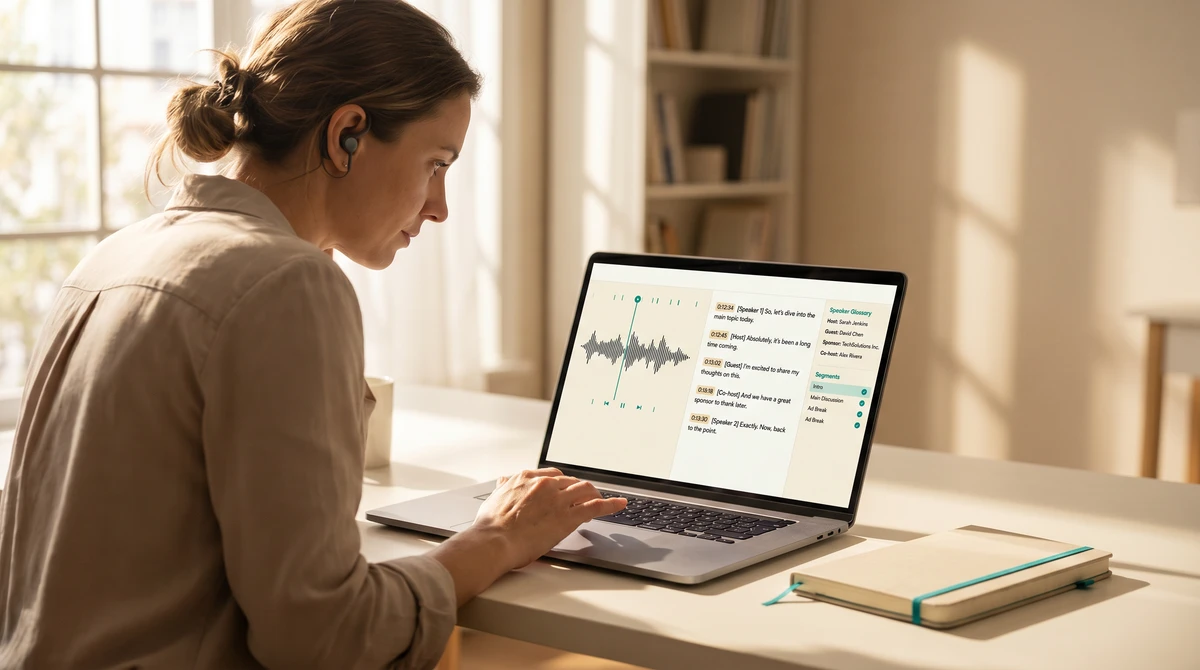
Podcast transcription services
Scope podcast transcription with format, speaker labels, and timestamps settled first.
Turn podcast episodes into accurate written transcripts with speaker labels, timestamps, format style (verbatim or clean), and output file type confirmed in writing before the first episode is processed.
Upload files for a quote
Short form: name, work email, runtime, platform, target languages, and media files or links if ready.
Coverage reviewed per show
Delivery date confirmed in writing per scope before work begins
Glossary preserved across episodes
Dynamic Dialects supports requests across 250+ languages with ISO 9001/27001 operating controls, ISO 17100 applied to translation scopes, 40,000+ vetted linguists, named project coordination, and written confirmation before production work begins.
Evidence for review
What DD can show before a buyer commits.
This is not a public case study claim. It is DD-owned evidence a buyer can request when the work needs vendor review before a scope is approved.
Ask for proof details- Buyer type
- Podcast transcription services media producer, localization manager, or accessibility lead checking runtime, platform format, speaker rules, and output spec before production.
- Problem
- The buyer needs podcast transcription services scoped by runtime, platform, target languages, speaker treatment, timing constraints, and output files before quote approval.
- Scope
- Podcast transcription services work coordinated by DD with written request review, named PM ownership, and review records matched to the request type.
- Constraint
- This page cannot rely on a public case study yet; it must point to DD-owned proof artifacts and disclosure-safe process evidence.
- DD action
- DD confirms the inputs, missing details, staffing option, quality check, and delivery record before production work begins.
- Evidence available
- Private proof can include a request-specific checklist, redacted QA summary format, delivery record format, and sourcing or reviewer notes.
- Outcome
- The buyer can judge whether DD fits the requirement before sending production files or adding this service to a vendor shortlist.
- Disclosure status
- DD-owned proof only. Public outcomes require client approval; redacted process artifacts can be shared when terms allow.
How the work runs
-
Scope the show
Episode source, target output format, transcription style (verbatim or clean), speaker labels, timestamps, and any glossary recorded in writing first.
-
Capture the show glossary
Recurring host names, brand terms, subject vocabulary, and sponsor names captured during the first episode and locked for reuse across the season.
-
Transcribe the audio
Subject-matched transcriber works in tracked segments with speaker change detection, unclear-audio flags, and the show glossary applied per turn.
-
Run reviewer pass
A second qualified transcriber checks accuracy, speaker-label consistency, and glossary use against the first-episode lock before delivery.
-
Deliver in your output format
Transcript in the requested file format (TXT, DOCX, SRT, VTT, JSON) ready for show notes, accessibility upload, or content repurposing.
What DD checks before quoting
- Source file review Completeness, legibility, format, and any visible damage or quality issues.
- Pair confirmation Source → target language, variant, dialect, and script requirements.
- Purpose check Receiving office, certification or notarization need, and deadline driver.
- QA plan Review type, sample size, sign-off owner, and any client-specific checklist.
- Delivery format File type, naming convention, storage method, and handoff protocol.
- Risk note Known constraints, specialist availability, and contingency if timing shifts.
Example scope — actual checks vary by project type and client requirements.
Each podcast transcription project starts with a written request check confirming episode source, target output format (TXT, DOCX, SRT, VTT, JSON), transcription style (verbatim or clean read), speaker-label expectation, timestamp cadence, and any glossary of recurring names or terms. Transcribers are matched to the show's subject area (business, health, tech, education, current affairs) rather than assigned at random. Turnaround for a 60-minute episode is confirmed in writing per scope before work begins; recurring weekly shows are scoped on a defined cadence with the same transcriber where continuity matters.
For media work, DD checks source quality, timing, platform format, speaker treatment, and output files before quoting.
What this page helps you send
- Show notes and episode summaries for podcast websites, RSS, and SEO indexing.
- Accessibility transcripts for listeners who are deaf, hard-of-hearing, or prefer reading.
- Searchable content libraries for back catalogs across multiple seasons or hosts.
- Multilingual transcripts for shows with international audiences or guests speaking other languages.
- Verbatim transcripts for legal, research, or journalism use where every filler word matters.
- Clean-read transcripts for marketing assets, quote pulls, and republishing as written content.
- Multi-speaker shows with speaker labels and reliable speaker change detection.
- Recurring weekly or daily shows on a defined cadence with style consistency across episodes.
What you receive
- Transcript in the requested output format with speaker labels and timestamps applied per the agreed style.
- Show glossary captured during the first episode and reapplied across subsequent episodes for consistency.
- Transcriber notes for unclear audio, cross-talk, off-mic comments, and any name or term flagged for confirmation.
- Edit-ready file format suitable for show notes, blog post repurposing, or accessibility upload.
- Recurring-cadence delivery on a confirmed schedule when a show runs weekly or daily.
Questions teams ask first
What is the difference between verbatim and clean transcription?
Verbatim transcription includes every spoken word: filler words (um, uh, like), false starts, repetitions, and stutters. Use verbatim for legal, research, or journalism work where exact speech matters. Clean transcription removes filler and corrects false starts so the transcript reads as a written piece. Use clean for marketing assets, blog repurposing, and accessibility transcripts where readability is the goal.
How are speaker labels handled?
Speaker labels are confirmed in the request check: named speakers (Host: Alex, Guest: Sam) or generic (Speaker 1, Speaker 2, Speaker 3). For multi-speaker shows with reliable mic separation, speakers are labeled per turn. For shows where speakers talk over each other or share mics, the transcript marks overlapping speech and flags ambiguous turns rather than guessing.
What timestamp cadences are supported?
Per-speaker-turn timestamps (most common for show notes), per-paragraph timestamps, per-sentence timestamps, or per-minute timestamps for long-form content. Sub-second timestamps are available when the transcript will be used to seek a specific moment in the recording.
How are recurring weekly shows handled?
A show glossary is captured during the first episode (host names, recurring co-hosts, brand terms, subject vocabulary, sponsor names, episode-format conventions) and reapplied across subsequent episodes. Where possible the same transcriber stays with the show so style and pacing carry forward. Delivery runs on the cadence the show team prefers (per-release, daily, or weekly batch).
How long does a 60-minute episode take?
Turnaround is confirmed in writing per scope before work begins once clean audio is uploaded. Multi-speaker shows, shows with heavy cross-talk, and shows recorded in challenging environments take longer and are quoted with a confirmed delivery date in writing. Expedited turnaround is available for time-sensitive releases.
Are multilingual podcasts handled?
Yes. Coverage spans 250+ languages including rare and minority languages where most transcription marketplaces cannot source qualified transcribers. For shows with code-switching between languages (a common pattern in diaspora-community podcasts), the transcript handles each language segment in its native script with a translator note where helpful.
What output formats are supported?
TXT (plain text), DOCX (Word document with styled paragraphs and timestamps), SRT and VTT (subtitle-format files with timing built in), and JSON (machine-readable transcript with structured timestamps and speaker labels per turn). Output format is confirmed in the request check so the transcript drops into the downstream workflow without a separate conversion step.
Can the transcript be repurposed for blog posts or show notes?
Yes. Clean-read transcripts are written so they read naturally as a written piece. They can be repurposed directly as blog posts, used as raw material for show notes, or quote-pulled for marketing assets. For shows that want a separate summary or chapter breakdown, that scope is added during the request check rather than improvised after delivery.