
Native voice talent pool per market with regional accent options
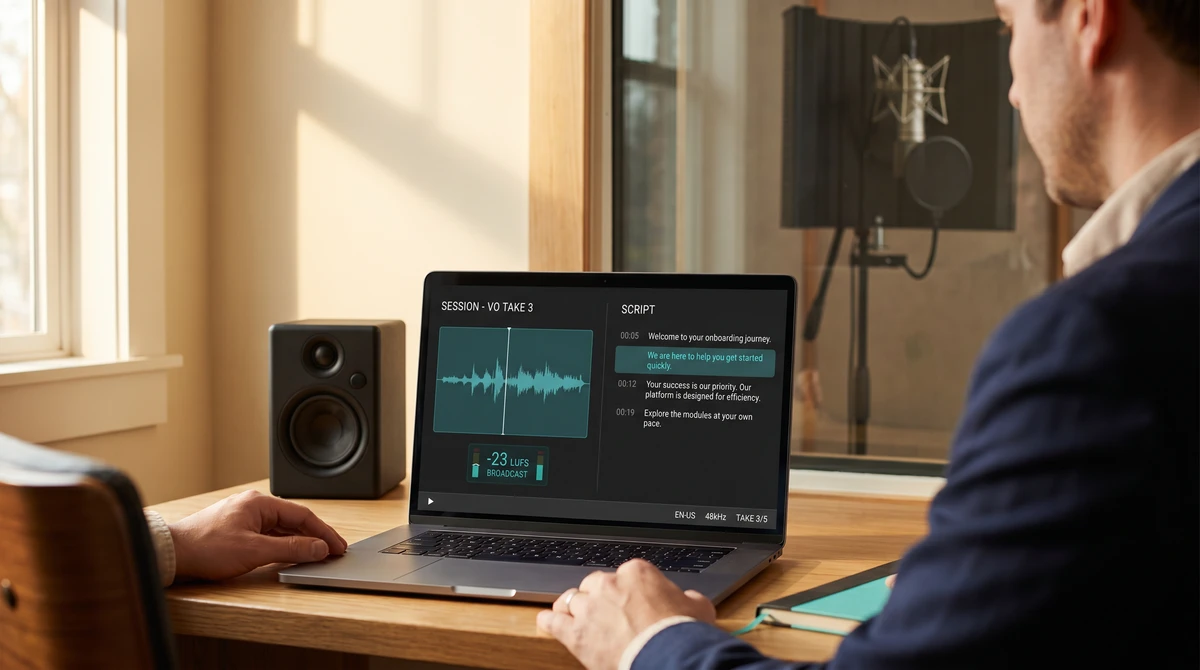
Voiceover production services
Scope voiceover production with content type, target languages, casting, and audio spec settled first.
Produce voiceover audio (corporate, e-learning, marketing, IVR, audiobook, podcast, voice assistant prompt) in target languages with content type, voice casting, audio specification, and delivery format settled in writing before the studio session is booked.
Upload files for a quote
Short form: name, work email, runtime, platform, target languages, and media files or links if ready.
Corporate, e-learning, marketing, IVR, audiobook, podcast, voice assistant
Per-platform loudness target (-23 LUFS broadcast, -16 LUFS streaming)
Professional studio production and remote home-studio production with engineer review
Dynamic Dialects supports requests across 250+ languages with ISO 9001/27001 operating controls, ISO 17100 applied to translation scopes, 40,000+ vetted linguists, named project coordination, and written confirmation before production work begins.
Evidence for review
What DD can show before a buyer commits.
This is not a public case study claim. It is DD-owned evidence a buyer can request when the work needs vendor review before a scope is approved.
Ask for proof details- Buyer type
- Voiceover production services media producer, localization manager, or accessibility lead checking runtime, platform format, speaker rules, and output spec before production.
- Problem
- The buyer needs voiceover production services scoped by runtime, platform, target languages, speaker treatment, timing constraints, and output files before quote approval.
- Scope
- Voiceover production services work coordinated by DD with written request review, named PM ownership, and review records matched to the request type.
- Constraint
- This page cannot rely on a public case study yet; it must point to DD-owned proof artifacts and disclosure-safe process evidence.
- DD action
- DD confirms the inputs, missing details, staffing option, quality check, and delivery record before production work begins.
- Evidence available
- Private proof can include a request-specific checklist, redacted QA summary format, delivery record format, and sourcing or reviewer notes.
- Outcome
- The buyer can judge whether DD fits the requirement before sending production files or adding this service to a vendor shortlist.
- Disclosure status
- DD-owned proof only. Public outcomes require client approval; redacted process artifacts can be shared when terms allow.
How the work runs
-
Scope the program
Content type, target languages with accent specification, voice casting, audio specification, and delivery format settled in writing first.
-
Cast the voice
Native voice talent per market cast against the agreed voice profile. Audition samples shared with the client for approval before booking.
-
Translate and script-prep
Source script translated against the style guide. Read-aloud test on the target script with the voice director before the studio session.
-
Record in the booth
Native voice director supervises the session. Audio engineer reviews every clip against the spec; failed clips re-recorded in the session.
-
Master to platform spec
Audio mastered to the target loudness (-23 LUFS broadcast, -16 LUFS streaming, -19 LUFS podcast). Delivery in WAV, MP3, or AAC per the platform spec.
What DD checks before quoting
- Source file review Completeness, legibility, format, and any visible damage or quality issues.
- Pair confirmation Source → target language, variant, dialect, and script requirements.
- Purpose check Receiving office, certification or notarization need, and deadline driver.
- QA plan Review type, sample size, sign-off owner, and any client-specific checklist.
- Delivery format File type, naming convention, storage method, and handoff protocol.
- Risk note Known constraints, specialist availability, and contingency if timing shifts.
Example scope — actual checks vary by project type and client requirements.
Each voiceover production program starts with a written specification confirming content type (corporate narration, e-learning module, marketing video voiceover, IVR menu prompts, audiobook narration, podcast intro and outro, voice assistant prompts), target languages and locales (with regional accent specification), voice casting approach (single voice across the program or character voice differentiation, with audition samples reviewed before booking), audio specification (sample rate, bit depth, channel layout, target loudness per platform: -23 LUFS for broadcast EBU R128, -16 LUFS for streaming, -19 LUFS for podcast), studio setup (native-language professional voice studio per market or remote home-studio production with audio engineer review), and delivery format (WAV, MP3, AAC at the platform spec). Native voice directors supervise sessions with the voice talent.
For media work, DD checks source quality, timing, platform format, speaker treatment, and output files before quoting.
What this page helps you send
- Corporate narration for training videos, executive videos, and internal communications across target markets.
- E-learning module voiceover for SCORM and xAPI content with consistent voice across multi-module programs.
- Marketing video voiceover, social media ad voiceover, and explainer video narration.
- IVR menu prompts, hold messages, and call-center connection announcements per locale.
- Audiobook narration and podcast voice production with platform-spec audio mastering.
What you receive
- Voiceover audio files in the agreed format and specification with audio engineer review on every clip.
- Voice casting audition samples for client approval before the recording session is booked.
- Audio mastering to the platform loudness target (-23 LUFS broadcast, -16 LUFS streaming, -19 LUFS podcast).
- Per-file metadata naming convention applied per the client delivery format.
- Re-record and re-master scope for source script revisions at no additional studio cost when in scope.
Questions teams ask first
Which content types are supported?
Corporate narration, e-learning module voiceover (SCORM and xAPI content), marketing video voiceover, social media ad narration, IVR menu prompts and call-center announcements, audiobook narration, podcast voice production, and voice assistant prompts (TTS pretrained alternative for brands that want human-voiced prompts). The content type is confirmed in scoping so voice talent with the matching reading style is cast.
How is voice casting handled?
Native voice talent per market is cast against the agreed voice profile (gender, age range, accent, tone, reading style). Audition samples are produced from a representative script section and shared with the client for approval before the full session is booked. For multi-character content (e-learning roleplay, audiobook), character voice differentiation is scoped per character with separate casting.
What loudness targets are honored per platform?
Standard platform loudness targets are -23 LUFS for EBU R128 broadcast, -24 LUFS for ATSC A/85 US broadcast, -16 LUFS for streaming platforms (YouTube, Spotify normalized), -19 LUFS for podcasting (Apple Podcasts and Spotify podcast spec), and -14 LUFS for music-platform audio content. The target is confirmed in scoping so the audio masters drop directly into the distribution pipeline.
Is remote home-studio production supported?
Yes. Remote home-studio production is supported when the voice talent has a treated home studio meeting the agreed audio specification (low noise floor, appropriate microphone class, treated acoustics). An audio engineer reviews every clip against the spec and re-records sections that fail the noise-floor or signal-level check. For broadcast-grade content, professional studio production per market is the default.
How are scripts handled for multi-language programs?
Source scripts are translated against the agreed style guide before recording, with target-language scripts reviewed for spoken-language naturalness (read-aloud test) rather than only written-language accuracy. The voice director reviews the translated script with the voice talent before recording so awkward phrasing is caught and adjusted before the studio session.