
Including JA, KO, ZH-CN, ZH-TW, ES-MX, PT-BR, AR primary gaming markets
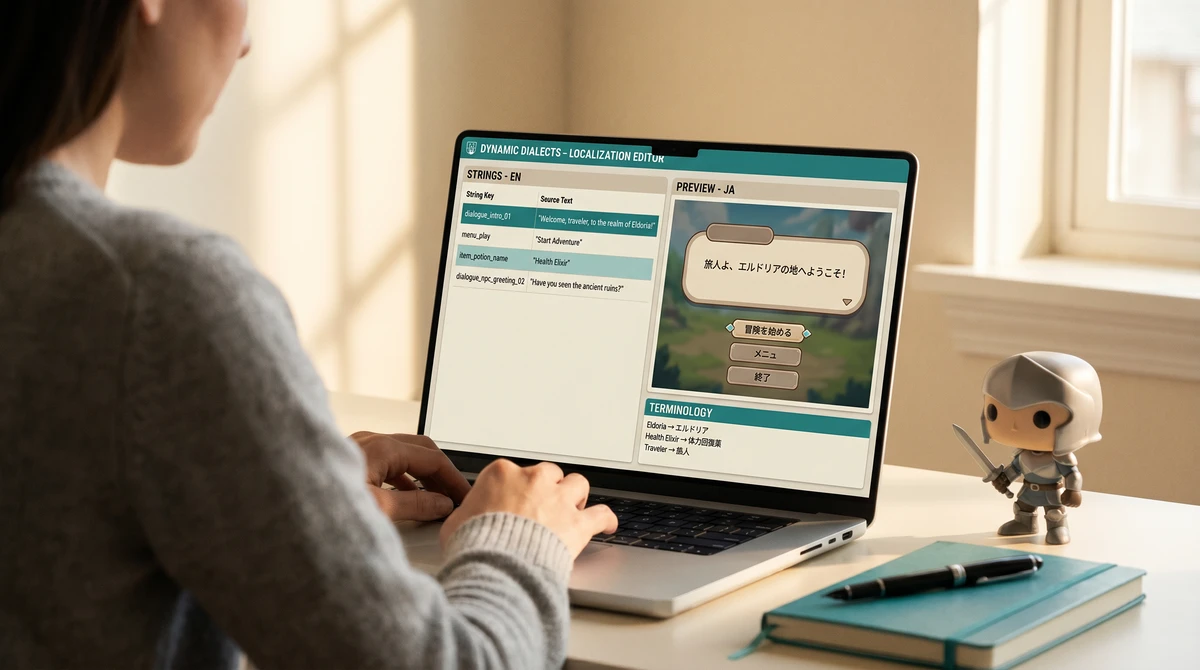
Game localization services
Scope game localization with engine, target markets, voice scope, and LQA pass settled first.
Localize a game for the target markets with engine integration, string budgets, voice acting scope, cultural adaptation pass, and Localization QA on the playable build settled in writing before the first string is opened.
Upload files for a quote
Short form: name, work email, target markets, launch date, and files or screenshots if ready.
Unity, Unreal Engine, Godot, custom engines, engine-specific resource bundles
Voice acting, lip-sync dubbing, ADR re-recording across target languages
Linguistic playtesting on the playable build with studio bug-tracker integration
Dynamic Dialects supports requests across 250+ languages with ISO 9001/27001 operating controls, ISO 17100 applied to translation scopes, 40,000+ vetted linguists, named project coordination, and written confirmation before production work begins.
Evidence for review
What DD can show before a buyer commits.
This is not a public case study claim. It is DD-owned evidence a buyer can request when the work needs vendor review before a scope is approved.
Ask for proof details- Buyer type
- Game localization services product manager, internationalization lead, or content strategist checking market fit, string context, term lists, and import method before release.
- Problem
- The buyer needs game localization services scoped by target markets, source files, term lists, character limits, QA approach, and import method before release.
- Scope
- Game localization services work coordinated by DD with written request review, named PM ownership, and review records matched to the request type.
- Constraint
- This page cannot rely on a public case study yet; it must point to DD-owned proof artifacts and disclosure-safe process evidence.
- DD action
- DD confirms the inputs, missing details, staffing option, quality check, and delivery record before production work begins.
- Evidence available
- Private proof can include a request-specific checklist, redacted QA summary format, delivery record format, and sourcing or reviewer notes.
- Outcome
- The buyer can judge whether DD fits the requirement before sending production files or adding this service to a vendor shortlist.
- Disclosure status
- DD-owned proof only. Public outcomes require client approval; redacted process artifacts can be shared when terms allow.
How the work runs
-
Scope the program
Engine, platform, target markets, voice acting scope, cultural adaptation pass, age-rating compliance, and LQA scope settled in writing first.
-
Set up the in-engine pipeline
String exports from Unity, Unreal, Godot, or the custom engine flowed into the CAT tool with the project termbase and translation memory active.
-
Translate against the termbase
Per-element UI length budgets respected. Character names, item names, and recurring phrases stay consistent across the title via the project termbase.
-
Record voice and dub cutscenes
Native voice directors cast per language. Lip-sync matched for visible-mouth cutscenes; ADR for content changes that arrive after the initial recording pass.
-
Run LQA on the playable build
Linguistic playtesting on PC, console dev kit, or device build. Bugs filed in the studio tracker with build version, language, and reproduction steps.
What DD checks before quoting
- Source file review Completeness, legibility, format, and any visible damage or quality issues.
- Pair confirmation Source → target language, variant, dialect, and script requirements.
- Purpose check Receiving office, certification or notarization need, and deadline driver.
- QA plan Review type, sample size, sign-off owner, and any client-specific checklist.
- Delivery format File type, naming convention, storage method, and handoff protocol.
- Risk note Known constraints, specialist availability, and contingency if timing shifts.
Example scope — actual checks vary by project type and client requirements.
Each game localization program starts with a written specification confirming engine and platform (Unity, Unreal Engine, custom engine for PC, PlayStation, Xbox, Nintendo Switch, iOS, Android, VR), source file format (XLIFF, JSON, YAML, PO, RESX, CSV, or engine-specific resource bundle), target markets (Japan, Korea, China Simplified, China Traditional, LATAM Spanish-Mexico, LATAM Portuguese-Brazil, MENA Arabic, plus Western Europe), UI string length budgets per element (button labels, menu items, tooltips, dialogue boxes have different max-character allowances per language), voice acting scope (in-game dialogue lines, character voice casting, voice direction, dialogue recording, lip-sync dubbing or ADR), cultural adaptation pass (religious and political sensitivity, age-rating compliance for PEGI, ESRB, CERO, USK), and Localization QA (LQA) scope on the playable build (linguistic playtesting, bug reporting in the studio's bug tracker, console TRC alignment). Source strings are processed in the CAT tool with the project termbase and translation memory active so character names, item names, and recurring phrases stay consistent across the entire title.
For localization work, DD checks files, screenshots, term lists, character limits, feedback needs, and release format.
What this page helps you send
- In-game dialogue and narrative localization (quest text, cutscene scripts, ambient NPC chatter, lore entries) with character-voice consistency.
- UI string localization with per-element length budgets, plural and gender rule handling per language, and RTL support for Arabic and Hebrew.
- Voice acting and casting across target languages with native voice directors and recording supervision.
- Lip-sync dubbing for cutscenes and dialogue-heavy character moments where mouth movement is visible to the player.
- Cultural adaptation (culturalization) for religion, politics, gore, gambling, and locally sensitive content per market age rating.
- Localization QA (LQA) and linguistic playtesting on the playable build with bug reporting in the studio's tracker (Jira, ShotGrid, or equivalent).
- Live ops localization for free-to-play (F2P) games with weekly or fortnightly content drops translated against the active TM and termbase.
- Console TRC (Technical Requirements Checklist) alignment for PlayStation, Xbox, and Nintendo certification submissions.
What you receive
- Localized resource files in the source format, re-imported back into the engine with string keys preserved.
- Voice acting and dubbing audio files in the agreed format (typically WAV at the engine's sample rate), per-line and per-character organized.
- Cultural adaptation report flagging any source content that required adjustment per market and the agreed alternative wording.
- LQA bug list filed in the studio's bug tracker with severity, language, build version, and reproduction steps recorded.
- Translation memory (TMX) and termbase (TBX) returned for the next update, DLC, or sequel program.
Questions teams ask first
How is game localization different from software localization?
Software localization focuses on UI strings, on-screen text, error messages, and product documentation with length budgets, placeholder integrity, and platform style guides. Game localization adds narrative content (in-game dialogue, cutscene scripts, ambient NPC chatter, lore entries), voice acting and casting across languages, lip-sync dubbing for cutscenes, cultural adaptation (culturalization) per market, age-rating compliance per region, and Localization QA on the playable build itself. Most games need both UI localization and content localization scoped together.
Which game engines and file formats are supported?
Unity (XLIFF, custom ScriptableObject exports, Localization Package), Unreal Engine (LocRes, PO, CSV via the Localization Dashboard), Godot, and custom engines that export to XLIFF, JSON, YAML, PO, RESX, or CSV are supported end-to-end. The exported strings are translated in the CAT tool with the project termbase and TM active, then re-imported into the engine with all string keys preserved so the engine binds correctly to the localized text at runtime.
How are UI string length budgets handled per language?
UI elements (button labels, menu items, tooltips, dialogue boxes, on-screen prompts) have per-element max-character allowances that vary by language. German typically runs 30 to 40 percent longer than English. Japanese and Chinese typically run shorter in character count but require font-width consideration. The translator works against the per-element budget recorded in the spec, and an LQA pass on the build confirms no string overflows the on-screen rectangle. RTL languages (Arabic, Hebrew) need engine support for mirrored UI layout, scoped separately.
How is voice acting and casting handled?
Voice acting for game localization is staffed per language with native voice directors and casting auditions per character. Recording happens in studio against the agreed audio specification (typically 48 kHz, 24-bit, mono per character) with the voice director on the session. Lip-sync dubbing for cutscenes uses the visual mouth movement timing from the source as the constraint, with line-length and phonetic alignment matched per language. ADR (automated dialogue replacement) re-recording is used for content changes that arrive after the initial recording pass.
What is culturalization and which markets need it?
Culturalization is a pass over the game content that adjusts religious, political, historical, gore, gambling, and locally sensitive material so the localized build fits the cultural expectations of the target market and the age-rating boards (PEGI for Europe, ESRB for North America, CERO for Japan, USK for Germany, CCG for China, GRAC for Korea). Common adjustments include flag and symbol substitution, religious imagery softening, history and geography wording, and gore-level reduction for markets with stricter rating standards. The culturalization scope is confirmed per market in the program scope.
How is LQA (Localization Quality Assurance) run on the playable build?
LQA is run on the playable build (PC, console dev kit, or device build for mobile and VR) by native-language linguistic testers who play the game in the target language and file bugs for string overflows, missing strings, wrong context, missed cultural-adaptation flags, voice timing issues, lip-sync misalignment, and on-screen text rendering issues. Bugs are filed in the studio's bug tracker (Jira, ShotGrid, or equivalent) with severity, language, build version, and reproduction steps. Multiple LQA passes are scoped as needed for live ops, DLC, and sequel updates.
How is live ops localization handled for F2P games?
Live ops localization runs against the existing project TM and termbase so weekly or fortnightly content drops (new events, characters, items, story chapters) translate consistent with the base-game wording. Turnaround windows are agreed per drop type (event copy typically tighter than narrative drops). The same translator pool is used across drops when continuity matters (character voice, narrative arc), with native reviewer approval before content goes live in the production build.
How is the program priced for game localization?
Pricing typically combines per-word for text content (UI and narrative), per-minute for voice acting and dubbing, per-bug or per-pass for LQA, and a culturalization fee per market when culturalization is in scope. The TM match report applies to text content so repeat strings and prior-update reuse price differently than no-match strings. The pricing model is confirmed per program scope before the project starts.