
Storyline, Rise, Captivate, Lectora, custom HTML5
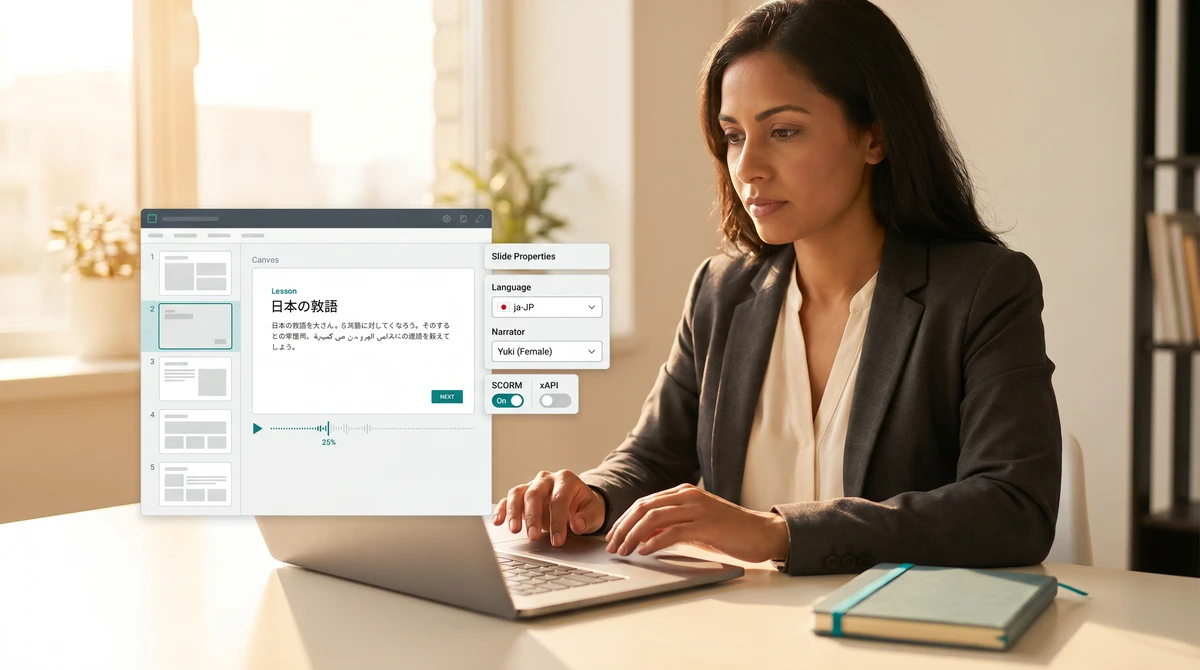
E-learning localization services
Scope e-learning localization with course tool, voice-over, and LMS handoff settled first.
Move training courses into target languages with course tool, voice-over scope, on-screen text, assessment translation, and LMS handoff confirmed in writing before any module is touched.
Upload files for a quote
Short form: name, work email, target markets, launch date, and files or screenshots if ready.
Coverage reviewed per module
Delivery date confirmed in writing per scope before work begins
LMS handoff formats confirmed up front
Dynamic Dialects supports requests across 250+ languages with ISO 9001/27001 operating controls, ISO 17100 applied to translation scopes, 40,000+ vetted linguists, named project coordination, and written confirmation before production work begins.
Evidence for review
What DD can show before a buyer commits.
This is not a public case study claim. It is DD-owned evidence a buyer can request when the work needs vendor review before a scope is approved.
Ask for proof details- Buyer type
- E-learning localization services product manager, internationalization lead, or content strategist checking market fit, string context, term lists, and import method before release.
- Problem
- The buyer needs e-learning localization services scoped by target markets, source files, term lists, character limits, QA approach, and import method before release.
- Scope
- E-learning localization services work coordinated by DD with written request review, named PM ownership, and review records matched to the request type.
- Constraint
- This page cannot rely on a public case study yet; it must point to DD-owned proof artifacts and disclosure-safe process evidence.
- DD action
- DD confirms the inputs, missing details, staffing option, quality check, and delivery record before production work begins.
- Evidence available
- Private proof can include a request-specific checklist, redacted QA summary format, delivery record format, and sourcing or reviewer notes.
- Outcome
- The buyer can judge whether DD fits the requirement before sending production files or adding this service to a vendor shortlist.
- Disclosure status
- DD-owned proof only. Public outcomes require client approval; redacted process artifacts can be shared when terms allow.
How the work runs
-
Scope the course
Course tool, source format, target languages, voice-over scope, on-screen text scope, assessment translation, and LMS handoff format recorded in writing first.
-
Map bidirectional and accessibility needs
Right-to-left layout-mirror for Arabic, Hebrew, and Urdu plus accessibility requirements (WCAG, closed captions, audio descriptions) scoped before translation begins.
-
Translate course content
On-screen text, interactive button labels, feedback messages, and assessment questions translated by subject-matched reviewers per language pair.
-
Record voice-over and subtitles
Voice-over recorded against the source timing; closed captions and subtitles aligned with the translated audio for accessibility and multi-format delivery.
-
Package for LMS handoff
Course packaged in the requested format (SCORM 1.2, SCORM 2004, xAPI/Tin Can, AICC) with multilingual manifest entries ready for LMS publish.
What DD checks before quoting
- Source file review Completeness, legibility, format, and any visible damage or quality issues.
- Pair confirmation Source → target language, variant, dialect, and script requirements.
- Purpose check Receiving office, certification or notarization need, and deadline driver.
- QA plan Review type, sample size, sign-off owner, and any client-specific checklist.
- Delivery format File type, naming convention, storage method, and handoff protocol.
- Risk note Known constraints, specialist availability, and contingency if timing shifts.
Example scope — actual checks vary by project type and client requirements.
Each e-learning localization project starts with a written request check confirming course tool (Articulate Storyline, Articulate Rise, Adobe Captivate, Lectora, custom HTML5), source file format (.story, .rise, .cptx, .awt, XLIFF export), target languages, voice-over scope, on-screen text scope, assessment translation, LMS handoff format (SCORM 1.2, SCORM 2004, xAPI/Tin Can, AICC), and any accessibility requirement. Bidirectional languages (Arabic, Hebrew, Urdu) are scoped with layout-mirror considerations before translation begins. Turnaround for a 60-minute course into one target language is confirmed in writing per scope before work begins; bundled multi-language launches and recurring quarterly course updates run on a confirmed cadence with the same translator and voice-over talent where continuity matters.
For localization work, DD checks files, screenshots, term lists, character limits, feedback needs, and release format.
What this page helps you send
- Compliance and safety training courses for global workforce rollouts across multiple time zones.
- Customer training and product certification programs adapted for international markets.
- Corporate L&D libraries with hundreds of modules requiring style consistency across the catalog.
- Healthcare and clinical training with terminology preserved across modules and patient-facing materials.
- Edtech and higher-education courses with multimedia, quizzes, and assessment translation.
- Sales enablement and onboarding courses for distributed teams in new market launches.
- Voice-over and subtitle translation for video lessons within larger course modules.
- Bidirectional language localization (Arabic, Hebrew, Urdu) with layout-mirror considerations applied.
What you receive
- Translated course files in the source tool's native format ready to publish to the LMS.
- Voice-over audio per target language matched to the original timing and pacing.
- Translated on-screen text, button labels, feedback messages, and assessment questions.
- Translated closed captions and subtitles for video lessons embedded in modules.
- LMS-ready package in the requested handoff format (SCORM, xAPI, AICC) with multilingual manifest entries.
Questions teams ask first
What course tools are supported?
Articulate Storyline, Articulate Rise, Adobe Captivate, Lectora, and custom HTML5 courses are handled in their native source formats. For courses built in less common tools, source files are handled as XLIFF export plus media assets so the translation works at the source level rather than as a screen-scrape.
How is voice-over scope confirmed?
Voice-over scope is one of the first questions in the request check: narration-only, lesson-video-only, full course, or no voice-over (subtitle-only). For full voice-over projects, target-language talent is matched to the source narrator's tone (warm instructional, formal authoritative, conversational), and timing is adapted to match the source pacing rather than mechanically dubbed.
How are SCORM and xAPI handoffs handled?
The LMS handoff format (SCORM 1.2, SCORM 2004, xAPI/Tin Can, AICC) is confirmed during the request check. The translated course is packaged in the requested handoff format with multilingual manifest entries so the LMS administrator can publish per locale without rebuilding the manifest. For LMS-specific quirks (Cornerstone, Workday, Moodle, Docebo, custom), the handoff is tested against the target LMS before final delivery.
How are bidirectional languages (Arabic, Hebrew, Urdu) handled?
Bidirectional languages are scoped with layout-mirror considerations applied before translation. On-screen UI elements (buttons, menus, navigation) are flipped to right-to-left orientation; text-direction tags are added to the source files; any embedded media that contains directional cues (arrows, progress bars) is checked. The translation itself is then completed with the layout work confirmed up front rather than retrofitted.
How are quiz and assessment questions translated?
Quiz and assessment translation is scoped per project because correct-answer mapping varies. Multiple-choice questions are translated with all option text adapted per market and the correct-answer key validated against the source. Open-response questions and feedback messages are translated with cultural-fit checks for sensitive content. Where assessment grading rules are subject-specific (clinical, legal, technical), a subject-matched reviewer checks the translated assessment before delivery.
How long does an e-learning localization take?
Turnaround for a 60-minute course (mixed text, on-screen elements, and one voice-over track) into one target language is confirmed in writing per scope before work begins. Larger courses, multi-language launches, and bundled catalog work are quoted with a confirmed delivery schedule in writing. Recurring quarterly course updates run on a confirmed cadence with the same translator and voice-over talent where continuity matters.
Can a single source course be released into multiple languages at once?
Yes. Multi-language launches are built from one source course with target-language scopes per language. Where a market has more than one language (Switzerland, Belgium, Canada), each language is scoped separately. Per-language timelines are confirmed so the global rollout holds across markets, and shared media assets (video, animation, course interactions) are produced once and reused per language pair.
What accessibility requirements are supported?
Closed captions for video lessons, audio descriptions for visual-only content, screen-reader-friendly alt text for images, keyboard navigation testing, and color-contrast checks against WCAG 2.1 AA. Accessibility scope is confirmed during the request check so the requirements are baked into the localization rather than added at the end.